Liangyu Fu
Library Blogs
Showing 1 - 10 of 2085 items
As the new semester begins, we are delighted to welcome Muyu Lin (林沐雨), the newest member of the Asia Library staff! Muyu joined us as the Asia Library Services Coordinator, and her first day was Tuesday, September 8, 2026.
Get a sneak peak at SCRC's upcoming Fall exhibit through our August “Recipe of the Month.” Drawn from Meals for Small Families by Jean Mowat, “Cocoa Sticks” epitomizes one of the key themes of the 1920s: an unapologetic use of commercially made and packaged foodstuffs in support of simple & speedy meal preparation.
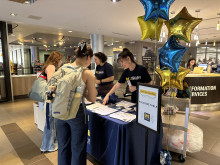
Following the successful pilot of the Asia Library Third Thursday open house series in Fall 2025, we continued the program in Winter 2026. Once again, the series was enthusiastically received, welcoming many visitors to explore the Asia Library’s collections, engage with colleagues, and learn more about the histories and cultures represented in our collections.
In July 2024, Library Information Technology launched Project DOR (Digital Object Repository), a multi-year project dedicated to the development of a new repository. The new repository will be used for digital collections to replace the existing digital collections platform. Project DOR will provide a brand new tailored solution for packaging, ingest, storage, and access to digital collections.
The University of Michigan (U-M) Library’s Library Information Technology (LIT) Division has collaborated with the Institutional Data Initiative (IDI) at the Harvard Law School Library. This joint pilot project reprocessed the U-M Library's Proceedings of the University of Michigan Board of Regents digital collection, which consisted of more than 55,000 scanned pages from 71 volumes, using the latest AI technologies. The team has produced three datasets with AI enhancements for better accessibility, browsability, and findability. The datasets, processing pipeline, and technical report are all openly available without restriction at the U-M Deep Blue Data Repository, ICPSR, Hugging Face, and arXiv for researchers and scholars worldwide.
When I began my Library Engagement Fellows project, I expected to spend most of my time organizing resources and learning a new digital platform. What I did not expect was how much I would learn about a region connected to my own family history. Over the course of two semesters, I worked with Librarian Jeff Martin to develop a research guide on Odisha, a state in eastern India, while gaining new perspectives on research, accessibility, and digital resource creation. My project began during the Fall 2025 semester and continued into the Winter 2026 semester. Working alongside Librarian Jeff Martin, I have been helping develop a South Asia LibGuide focused on Odisha, a state in eastern India. The guide is intended to serve as a resource for students, researchers, and community members interested in learning more about the region's history, culture, language, politics, and scholarly resources.
During my Summer Fellowship in Library User Experience, I explored wayfinding in U-M’s Hatcher Graduate Library. By reviewing past studies, speaking with library staff, and hearing directly from visitors, I gathered insights to design three conceptual wayfinding kiosk prototypes. This fellowship strengthened my research and design skills, while deepening my appreciation for the invisible design decisions that quietly help people feel confident and welcome in a public space.
•
During my summer internship at the University of Michigan's Art, Architecture & Engineering Library, I helped make historical international atomic energy reports more accessible by cataloging previously uncataloged microfiche reports. Although I expected a traditional engineering internship, the experience showed me how libraries support scientific research and innovation.
My primary responsibility was finding and recording metadata for reports so they could be discovered through the University of Michigan Library Catalog. I cataloged reports from organizations in Australia and Argentina, identifying publication details, report numbers, and abstracts while using library databases such as WorldCat. My co-intern and I also developed a standardized workflow that future interns can use to continue cataloging the collection.
The internship introduced me to library cataloging, metadata, and engineering gray literature while strengthening my research, communication, and problem-solving skills. I also attended presentations from librarians on topics including digitization, copyright, and information management, and toured several library facilities to learn how valuable research materials are preserved.
Working with historical nuclear energy reports connected to my interest in environmental engineering by highlighting how today's innovations are built on decades of previous research. Overall, the internship broadened my understanding of engineering by demonstrating that preserving and organizing scientific knowledge is just as important as creating new discoveries and that collaboration across disciplines is essential to advancing research.
My primary responsibility was finding and recording metadata for reports so they could be discovered through the University of Michigan Library Catalog. I cataloged reports from organizations in Australia and Argentina, identifying publication details, report numbers, and abstracts while using library databases such as WorldCat. My co-intern and I also developed a standardized workflow that future interns can use to continue cataloging the collection.
The internship introduced me to library cataloging, metadata, and engineering gray literature while strengthening my research, communication, and problem-solving skills. I also attended presentations from librarians on topics including digitization, copyright, and information management, and toured several library facilities to learn how valuable research materials are preserved.
Working with historical nuclear energy reports connected to my interest in environmental engineering by highlighting how today's innovations are built on decades of previous research. Overall, the internship broadened my understanding of engineering by demonstrating that preserving and organizing scientific knowledge is just as important as creating new discoveries and that collaboration across disciplines is essential to advancing research.
This month’s recipe offers a preview of Special Collections’ Fall exhibit: Faster and More Fun: American Home Cooking in the 1920s, with Chocolate Blanc Mange from Fun in the Kitchen (1927).