
What exactly is microfiche, and why did I spend my summer working with them as an engineering student? As a rising junior studying Environmental Engineering with interests in renewable energy systems and conservation engineering, I had imagined spending my summer in a laboratory or working on environmental projects. Instead, I found myself working with decades-old microfiche containing international atomic energy reports. While the setting was very different from a traditional engineering internship, it ended up giving me a completely new perspective on research, engineering, and the role libraries play in advancing scientific knowledge.
My primary responsibility was to help catalog a collection of uncataloged atomic energy reports so they could become searchable through the UM Library Catalog. Most of these reports only existed in our collection as microfiche. Microfiche are small sheets of photographic film that store miniature images of documents. Before this internship, I had never even seen microfiche, let alone used a microfiche reader to view one.
A typical day began by setting up a 20-pound microfiche reader, into which I could then load a fiche to magnify the pages to examine the report. I first worked through a series of reports published by the Australian Atomic Energy Commission, which helped me become familiar with the cataloging process because they followed relatively consistent formats. Once I had gained confidence, I moved on to reports from Argentina's Comisión Nacional de Energía Atómica, many of which were written almost entirely in Spanish. Cataloging these reports required extra attention to detail as I identified titles, authors, publication information, and other metadata despite the language barrier. From there, I followed the cataloging workflow that my co-intern and I gradually developed over the course of the summer to add each report to our cataloging spreadsheet.
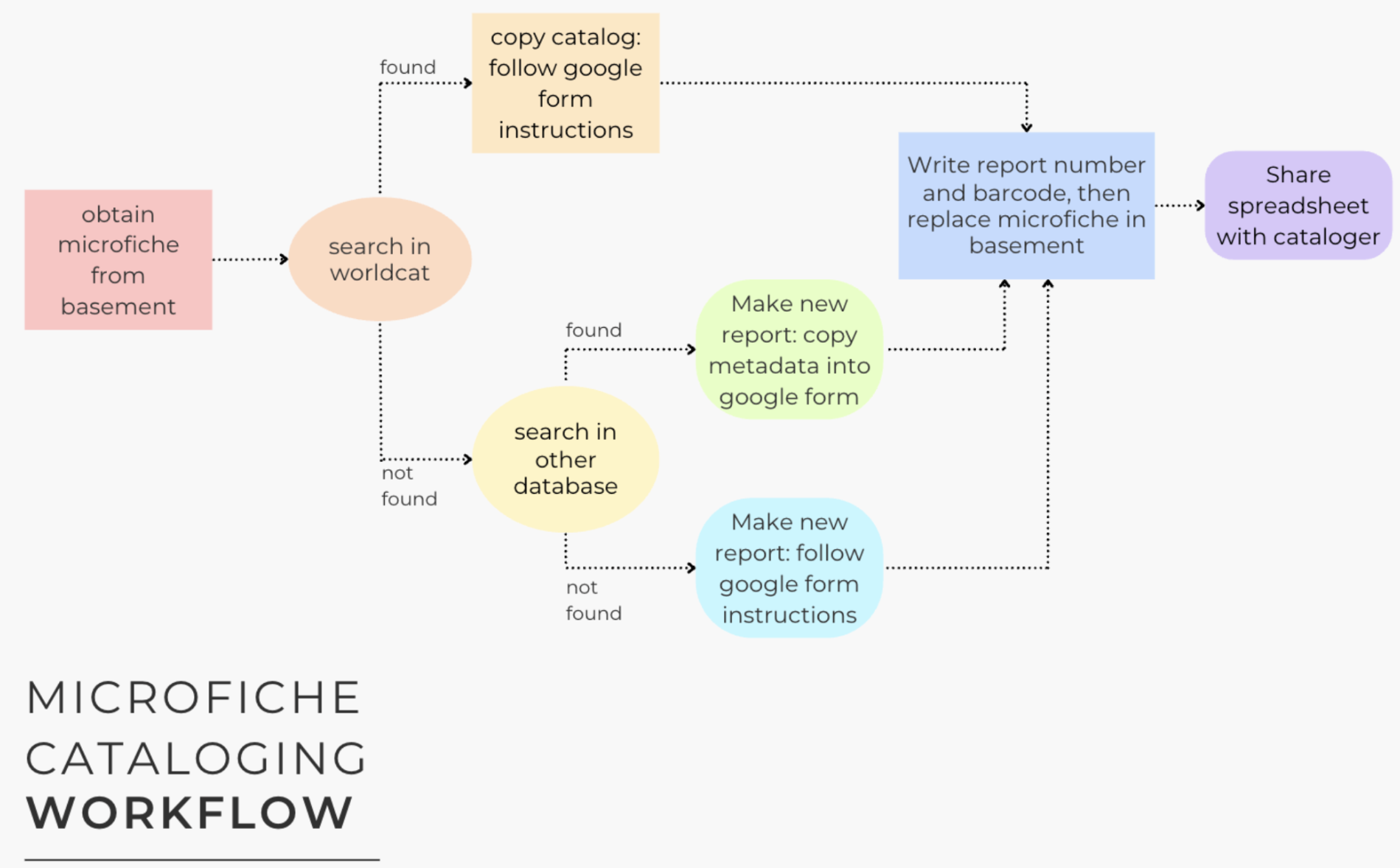
Workflow illustrating the process of cataloging microfiche reports by searching for existing records, creating new bibliographic records when necessary, and completing final processing before cataloger review.
The first step was searching for the report in WorldCat, the world's largest library catalog. If I found an existing record, it could be copied into our catalog with just a few edits. We used a Google Form which asked different questions depending on whether a record existed in a database or not. If no record existed, I created a completely new catalog record by entering information I found on the microfiche’s header and first few pages such as the title, authors, publication details, report numbers, and abstracts. After each report was completed, I wrote the report number and added a barcode onto the microfiche’s folder. Then the microfiche was ready to return to its home in the Art, Architecture, and Engineering Library basement. Once we had finished entering all microfiche into the Google Form, we shared the completed spreadsheet with our librarian mentor for review before it was shared with a cataloger to create a large batch of records to add to the UM library catalog. By the end of the internship, this workflow had become a clear guide that future interns can use to continue cataloging the remainder of the collection.
Cataloging required patience and attention to detail since no two reports were exactly the same. Many database reports were missing information, including lengthy abstracts. After testing a few methods, we found the fastest and most reliable method was transcribing them with UM-GPT. Checking over these transcriptions gave me the opportunity to strengthen my Spanish reading skills while interpreting technical information. Every successfully cataloged report felt like solving a small puzzle, and the experts I met throughout the internship helped me build the skills needed to piece everything together.
One of the highlights of my internship was getting to know the amazing people I met along the way. Paul Grochowski, our engineering librarian mentor, met with us weekly to answer questions, review our progress, and provide feedback. In addition, librarians and specialists from across the University Library joined Zoom meetings to teach us about topics like library cataloging, metadata, digitization, and even the nuances of copyright laws. I had never realized how many different careers exist within libraries or how much expertise goes into organizing information that researchers rely on every day.
The internship also included several behind-the-scenes tours that made the experience even more memorable. We explored the Hatcher Library, Duderstadt Center, Engineering Library, Book Arts Studio, and the Special Collections. Seeing these spaces gave me a much greater appreciation for the incredible resources available at the University of Michigan and the work required to preserve everything from rare books to historical engineering reports. Before this summer, I had no idea these collections and facilities even existed.
Throughout the internship, I developed skills that I know will be valuable in my future engineering career. I learned the basics of library cataloging, became familiar with engineering gray literature, and gained experience using specialized library databases and research tools. Just as importantly, I strengthened my written communication skills by helping document the cataloging workflow and presenting our project to the engineering library staff at the end of the summer.
As a student interested in sustainability and clean energy, I also found it fascinating to work with historical reports on nuclear energy. While nuclear power has a complicated history, it continues to be part of conversations about reducing carbon emissions and transitioning to cleaner energy sources. Reading reports from decades ago reminded me that today's engineering innovations are built upon generations of previous research. Preserving that knowledge is just as important as making new discoveries.
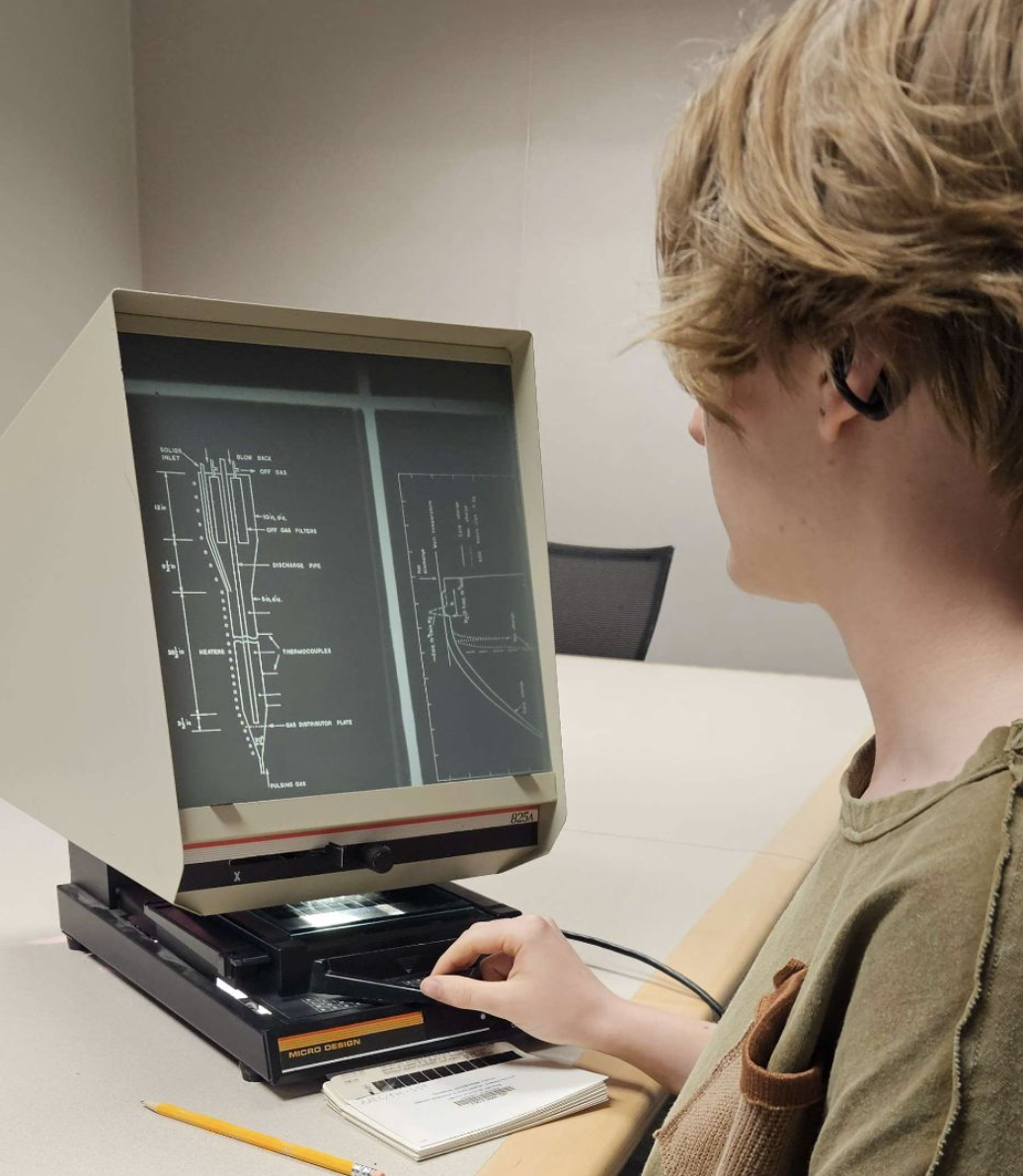
Author Atlas Fracasso using a microfiche reader to examine a technical report stored on a microfiche during the cataloging process.
Although this internship was not a traditional engineering experience, it showed me that engineering extends beyond design projects and laboratories. I strengthened my research and communication skills while gaining a deeper appreciation for the role that accurate information and collaboration play in advancing scientific progress. The experience reinforced my interest in environmental engineering and showed me that meaningful contributions to innovation can take many forms.