
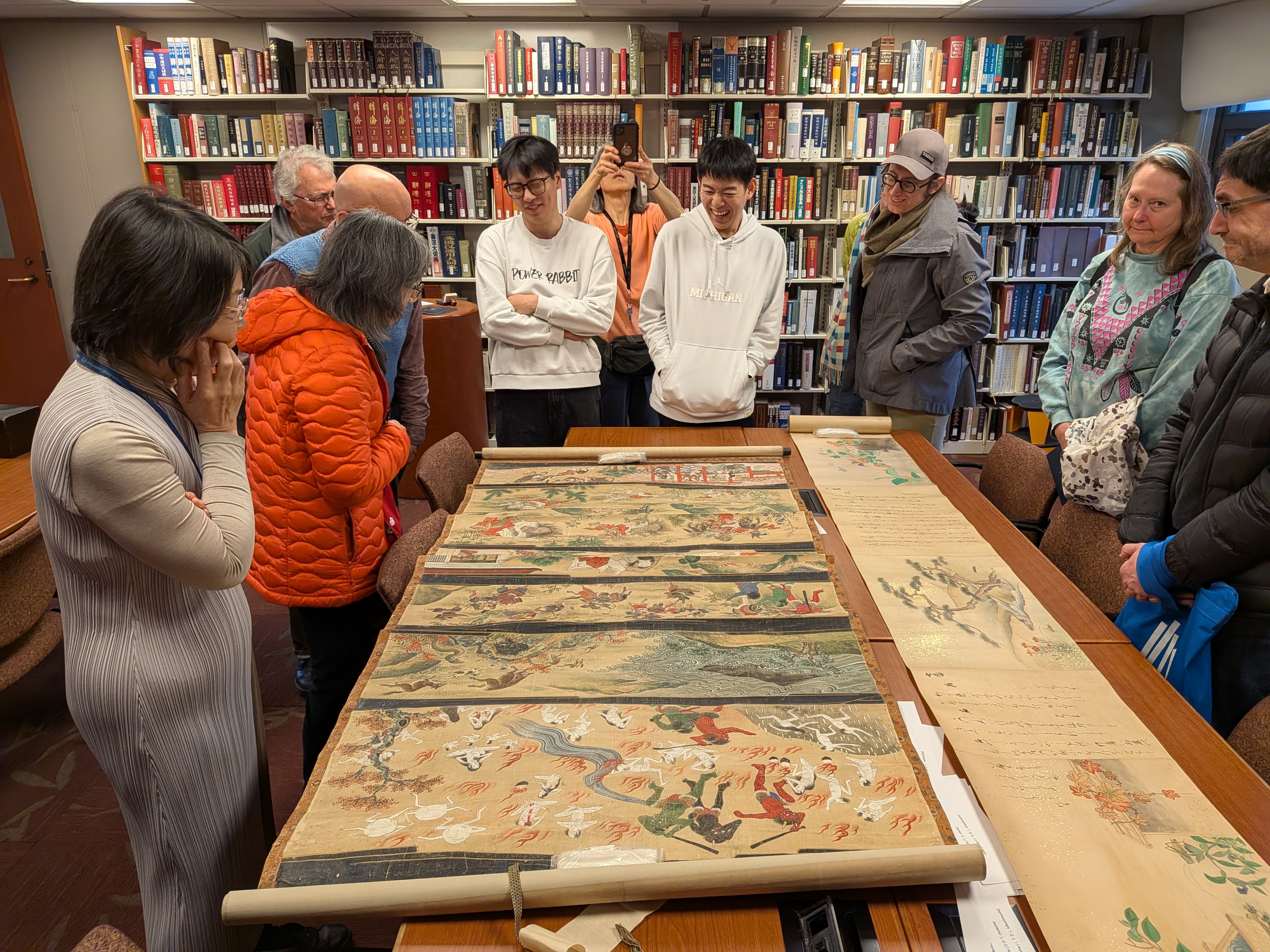
Visitors browsing items on display at the Asia Library Third Thursday event
(photo courtesy of Yung-hui Chou)
Following the successful pilot of the Asia Library Third Thursday open house series in Fall 2025, we continued the program in Winter 2026. Once again, the series was enthusiastically received, welcoming many visitors to explore the Asia Library’s collections, engage with colleagues, and learn more about the histories and cultures represented in our collections.
This semester, we experimented with a different curatorial model. While the Fall 2025 open houses used a collaborative, cross-East Asia approach, the Winter 2026 events featured more individualized curation centered on particular regions and languages. This shift allowed each program to explore its subject in greater depth and to highlight the specialized knowledge of individual curators. Both models proved valuable, and as we plan future Third Thursday programs, we anticipate alternating between these two approaches.
Another important development this semester was increased collaboration with campus partners. In April 2026, we partnered with the Lieberthal-Rogel Center for Chinese Studies (LRCCS) as part of its semester-long “Dancing with the Dragon” thematic programming. LRCCS helped promote the open house and generously lent several engaging objects for public display. This first campus partnership within the Asia Library Third Thursday series connected the program with a broader campus initiative and enriched the visitor experience.
Our winter programming also included a special pop-up exhibit on Korean music in April, which doubled as an end-of-semester de-stressing event. We partnered with Sunhong Kim, then PhD candidate in musicology, who contributed her academic expertise to the exhibit’s curation. Her newly released album--featuring the piri, a traditional Korean double-reed instrument--was played as part of the exhibit, adding an immersive musical dimension to the materials on display.
The series also gained visibility beyond the library. This January, Yung-hui Chou, our Chinese Studies Librarian, was invited to discuss the exhibit on Chinese martial arts fiction and culture on Speaking of Art, a program hosted by Ed Hoffman on WAAM TALK 1600, an Ann Arbor-based radio station. This media coverage offered exciting recognition of the Third Thursday series and its role in bringing the Asia Library’s collections and expertise to broader audiences.
Overall, the Winter 2026 Third Thursday series built successfully on the momentum of its pilot semester. Through regionally focused curation, new campus partnerships, creative programming, and expanded public visibility, the series continued to make Asia Library’s collections more approachable and engaging. We are grateful to our collaborators, colleagues, and visitors for their enthusiasm and support, and we look forward to carrying these lessons into future open houses.
January 2026
Sword and Scroll: Three Centuries of Chinese Martial Arts Fiction
The Chinese literary genre of wuxia 武俠 (martial arts fiction) poses an enduring challenge for translators, as no single English term captures the essence of the xiake 俠客—the Chinese martial arts hero. The xiake is defined less by extraordinary physical power and more by a commitment to justice and individual freedom, often prioritizing moral action over societal law and hierarchy. Rooted in ancient texts, the moral codes and martial skills of the xiake have fascinated generations of readers. The genre remains the most widely read form of popular literature and has inspired contemporary Kung Fu films and xiuxian 修仙 (cultivation) novels.
This Third Thursday, join the Asia Library staff to explore three centuries of the rich wuxia tradition, from its flourishing in the mid-Qing dynasty to the 21st century. On display are representative literary works—both translations and Chinese originals—tracing the development of the genre, alongside academic scholarship on its historical context, narrative aesthetics, and cultural impact. We would also like to share the legacy of these stories through adapted films, DVDs, and comic works that capture the collective memories of wuxia across generations of readers.
Curated by Yung-hui Chou (Chinese Studies Librarian).
February 2026
Rare Viewing: Mushi no Utaawase Emaki Scroll – Original Display
This Third Thursday, visit the Asia Library for a special viewing of the original scroll of Mushi no Utaawase Emaki 虫歌合絵巻. Scrolls like this are typically not exhibited in their entirety to protect their delicate materials, making this event a rare opportunity to experience a treasured gem from the Asia Library’s Special Collections.
The Mushi no Utaawase Emaki is a 56-foot-long Japanese picture scroll from the Edo period, in the 1800's, featuring 15 panels with text and watercolor paintings. It tells the story of a poetry contest in which fifteen pairs of insects compete by composing waka poems, all judged by a frog. Each section contains two poems by different insects, followed by the frog’s critique, and is accompanied by corresponding artwork. The scroll’s exact creator and author are unknown, though possible candidates include Hosokawa Yūsai or Kinoshita Katsutoshi. Traditionally, viewers enjoy the scroll one section at a time.
Curated by Keiko Yokota-Carter (Japanese Studies Librarian).
Item on display: Mushi no utaawase emaki 虫歌合絵巻
More information about the scroll:
March 2026
K-Library Collections: The Roots of Blossoming Korean Culture
K-pop and the Korean Wave (Hallyu) have taken the world by storm—captivating hearts and inspiring fascination—but the story of Korean culture stretches much deeper and further back. For more than a century, U-M scholars and librarians have explored these roots and built vibrant collections of Korean materials. Today, thanks to the dedication of scholars, donors, community members, and organizations in Korea, our library is home to over 100,000 Korean-language materials.
We warmly invite you to discover the richness and diversity of Korean culture at our upcoming exhibition. Step into a world of unique and historic treasures, spanning from the seventeenth century to the present and showcasing voices from both South and North Korea. Highlights include Akhak kwebom (樂學軌範, 1610), the Sambongjip Wooden Print Block (三峰集木版, 1791), the Han’gul Bible translated by John Ross (1887), issues of Nodong Sinmun, children’s literature, cartoons, and works by the acclaimed author Han Kang. Join us for this rare opportunity to experience the extraordinary legacy and dynamic spirit of Korean culture—there’s something here for everyone to explore!
Curated by Yunah Sung (Korean Studies Librarian).
April 2026
Tales & Scales: East Asian Dragons in Art, Literature, and Festive Traditions
The dragon may be an imaginary animal, but it is definitely a living tradition! For the final Third Thursday of this academic year, the Asia Library will partner with U-M's Lieberthal-Rogel Center for Chinese Studies (LRCCS) for a special open house celebrating the East Asian dragon (C: 龍/龙, J: 竜, K: 용). This event is part of LRCCS's "Dancing with the Dragon" (winter 2026), a semester-long program honoring the artistic creativity and collective spirit embodied by this fantastic creature.
While dragons are commonly associated with political power in East Asian tradition, we aim to present a more nuanced portrait through "Tales & Scales." The dragon is an auspicious, benevolent, and sometimes playful figure—a stark contrast to its Western counterpart. It appears in countless folk tales and remains active in everyday life through art, architecture, and vibrant festivals. The dragon dance, in particular, continues to be a vital celebration that fuses music, performing arts, and craftsmanship.
Our curated selection showcases the dragon's evolution across Chinese, Japanese, and Korean cultures. Visitors can explore catalogs and literary works alongside original artworks that capture the dragon's iconic yet diverse forms. From ancient mythology to contemporary pop culture, these materials highlight the dragon's enduring charm.
Curated by Yung-hui Chou (Chinese Studies Librarian), in collaboration with Keiko Yokota-Carter and Yunah Sung.
Special pop-up event in April 2026
Korea’s Sound Through the Centuries: From King Sejong to Folksongs and BTS
Step into a musical journey spanning more than 500 years, tracing Korea’s evolving soundscape from the reign of King Sejong (15th century) to today’s global phenomenon of K-pop.
Featuring selected library collections on Korean traditional music, 아리랑 (Arirang), K-pop, and BTS, this exhibition highlights how music reflects cultural identity, innovation, and social change across Korean history. Explore the stories that shaped Korean sound—from 정간보 (Chŏngganbo, 井間譜), one of the world’s earliest systems of music notation, to contemporary pop production, fandom, and global cultural influence.
Curated by Yunah Sung (Korean Studies Librarian), in collaboration with Helen Look (Collection Analyst, U-M Library) and Sunhong Kim (PhD candidate in Musicology, U-M).