Library Blogs

Showing 1 - 9 of 9 items
Results for Date: January 2026
A light gray skeleton for a mask, laying sideways on a wooden table. there are holes for the eyes and mouth, and other smaller holes to attach the rest of the mask through.
  • Elaine Qu
3D printed skeleton for a mask.
Headshot of Charlotte Sedlock
  • Charlotte Sedlock
Commodity production drives roughly 27% of global deforestation1. This loss accelerates biodiversity decline, degrades soils, and undermines forests’ capacity to sequester carbon. In response, governments are increasingly turning to market-based environmental governance mechanisms to curb deforestation in global supply chains. Notable examples include New York State’s proposed Tropical Rainforest Economic & Environmental Sustainability (TREES) Act and the European Union Regulation on Deforestation-Free Products (EUDR).
The EUDR, expected to enter into force in December 2026, will require producers of deforestation-risk commodities to provide polygon-level evidence that their products are deforestation-free. While these policies are designed to advance environmental goals, they also raise urgent questions about equity and inclusion in global supply chains.
At the center of these concerns are smallholder farmers. Small-scale and family farms manage approximately 87% of the world’s agricultural land2. In many deforestation-intensive value chains—such as timber, beef, and palm oil—smallholders make up a substantial share of producers3-5. Yet these actors often lack the financial, technical, and administrative capacity to comply with stringent traceability and verification requirements. As a result, many fear exclusion from global markets as sustainability regulations take effect.
This raises a critical question: Will well-intentioned deforestation governance inadvertently reinforce existing social inequities by pushing smallholders out of global supply chains?
cartoon style drawing of student meditating
  • Sean Patrick Hickey
Meditation has been deeply impactful in my life, and I want others to experience the positive shifts that come with it. Reflecting on my nine years of practice, I realized that current tools fail to track progress objectively or adapt to a person’s real-time needs. As a regular user of the Headspace app, I’ve often wondered if I’m performing the technique correctly or if my experience is actually deepening over time. A major limitation with standard guided meditations is their reliance on fixed-interval reminders. If a user loses focus ten seconds after an awareness reminder, they might spend the next few minutes lost in thought rather than training their mind. This inspired me to create a system where awareness reminders could adapt to the user by detecting when focus is lost and gently nudging them back immediately. This approach helps sustain awareness longer, naturally decreasing the need for reminders as the user’s skill improves.
The U-M Library mini grant provided the support needed to make this happen. With the funding to purchase a Muse Athena EEG (electroencephalography) headset, I brought the idea to my graduate Human Computer Interaction (HCI) course and teamed up with Alexander Bartolozzi, Donald Lin, and Annus Zulfiqar. Together, we built Reflect - an EEG-powered app that uses machine learning to accelerate the learning rate of meditation practices. It tracks meditation states in real-time, playing a gentle audio cue to restore awareness when the mind wanders, and dynamically adapts to the user's ability to maintain focus.
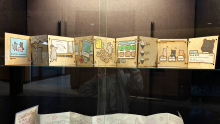
Rectangular covers and pentagonal flap with bands of colorful floral vegetal designs surrounded by brown leather frame boarders
  • Juli McLoone
Join us this Thursday, January 15th, between 4-6p for our first Third Thursdays at the Library event of the semester!
BJ Busch standing next to two colleagues at her retirement party
  • Alan Pinon
To the people that knew her best, Betty Jean “BJ” Busch was irrepressible. Busch had a highly successful career as a librarian and the focus of her family's gift in her memory is her educational experience at the University of Michigan and her early work as a cataloger at the U-M Library.
A colorful 3D printed geometric skull. Rather than a smooth (normal skull) surface, this print has a multifaceted pattern, so some of the edges catch the light, especially on the top of the skull. The top of the skull is red, around the eyes the print is orange, around the nose is yellow, the top of the jaw is light green, and the mandible is blue green/teal.
  • Sirong Guo
3D printed multi-color skull.
Two black 3D printed stands - one is holding Nintendo switch controllers, and a controller case, and the other is holding a nintendo Gamecube controller. All controllers are being held "standing up".
  • Nick Geiser
3D printed stands for Nintendo Switch and Gamecube controllers.
Hematite Uterine amulet
  • Pablo Alvarez
We are pleased to announce the opening of this exciting new exhibit at the Hatcher Gallery Exhibit Room! Explore a diverse array of Greco-Roman artifacts which were created to communicate with and call upon various unseen, supernatural forces for aid and protection. When? January 9-April 30, 2026.
Cover of The Man in the Iron Mask by Alexandre Dumas
  • Vicki J Kondelik
The Man in the Iron Mask is the final adventure in Dumas' Musketeer Saga. The former Musketeer, Aramis, now a bishop, plans to replace the villainous king, Louis XIV, with his identical twin brother, a masked prisoner in the Bastille. This novel brings the series to a thrilling conclusion, and it has inspired numerous film adaptations. But don't expect the novel to have the same ending as the 1998 film, which is probably the best-known adaptation.