
The Stamps MFA Cohort ‘25 created an artist catalogue titled stop-loss, documenting our thesis exhibition. The idea was born from a collective desire to bring our projects to print while understanding our work within the context of contemporary art theory. The book features seven second-year Stamps MFA students: Hannah Buchanan, Sam Griffith, Andy Maticorena Kajie, Laura Mackie, Okyoung Noh, Charlie Reynolds, and Darren Spirk. Each artist has four pages featuring photographs of their thesis exhibition in the Stamps Gallery. Wall text from the thesis show is juxtaposed alongside exhibition photos taken by Andy Maticorena Kajie. In addition to the MFA students, we also asked Stamps faculty, staff, and collaborators to contribute writings that analyze how the theses connect to each other and our current socio-political climate, including themes such as loss, climate futures, identity, politics, and landscape. The catalogue itself is about 50 pages, designed by Detroit-based designer Emily Anderson with the inclusion of thesis exhibition graphics by Sam Griffith. Detroit’s Inland Press printed 150 copies of the 5.5” x 8.5” saddle-stitched catalogues. This project is a way for us to reflect on and examine our work and the work of our peers, which merge visual practice with critical inquiry to foster dialogue.
The catalogue begins with an opening statement. In “Introductory Remarks from stop-loss: MFA Thesis Exhibition Opening,” Dylan AT Miner, the Stamps Senior Associate Dean for Research, Creative Practice, and Graduate Education, discusses the history of the show’s title. While the term “stop-loss” commonly carries political and financial connotations, Miner explains that the MFA students have intertwined the term with their own projects in unique ways.
Former (then current) MFA Program Director David Chung contributed an introduction as well, where he described an overview of each feature of the exhibition. He states of the MFA students, “Their work offers deeply personal inquiries into themes of memory, identity, history, and social justice, bound together by a shared commitment to storytelling as an act of reckoning and renewal (p. 11).”
Detroit-based cultural critic Vince Carducci wrote “stop-loss: Making Art in Dark Times” for the catalogue. His writing piece dissects how the title of the thesis show, stop-loss, relates to each of the MFA students’ works and how each student’s thesis pushes forward contemporary art research. Carducci says, “The artists in this exhibition have gathered themselves under the designation ‘stop-loss,’ a statement of resistance to authoritarian deprivation and their rightful place in the world (p. 15).” Carducci’s section wraps up the introductory statements and leads into the individual MFA featurettes, covering a range of themes from Korean history to queer theory to the psychology of memory to Indigenous sustainability, among others.
Lastly, at the very end of the catalogue, current (then incoming) Director of MFA Program Angela Washko contributed the piece “From Ephemeral to Concrete: Transitory states and methods of resistance against pervasive ambient (and also... not so ambient) violence.” Washko’s writing took the form of a series of letters addressed to each MFA student, touching on their studio practices and her personal relationships to each.
The Result: All the voices involved in this project helped make this project possible and the resulting catalogue exceeded our expectations.The introductory and closing remarks by Stamps faculty/staff and Vince Carducci were thought-provoking and genuine. The catalogue design by Sam and Emily (and brought to print by Inland Press) was wonderful, as it gave the book a visual unity that brought our different thesis topics together seamlessly.
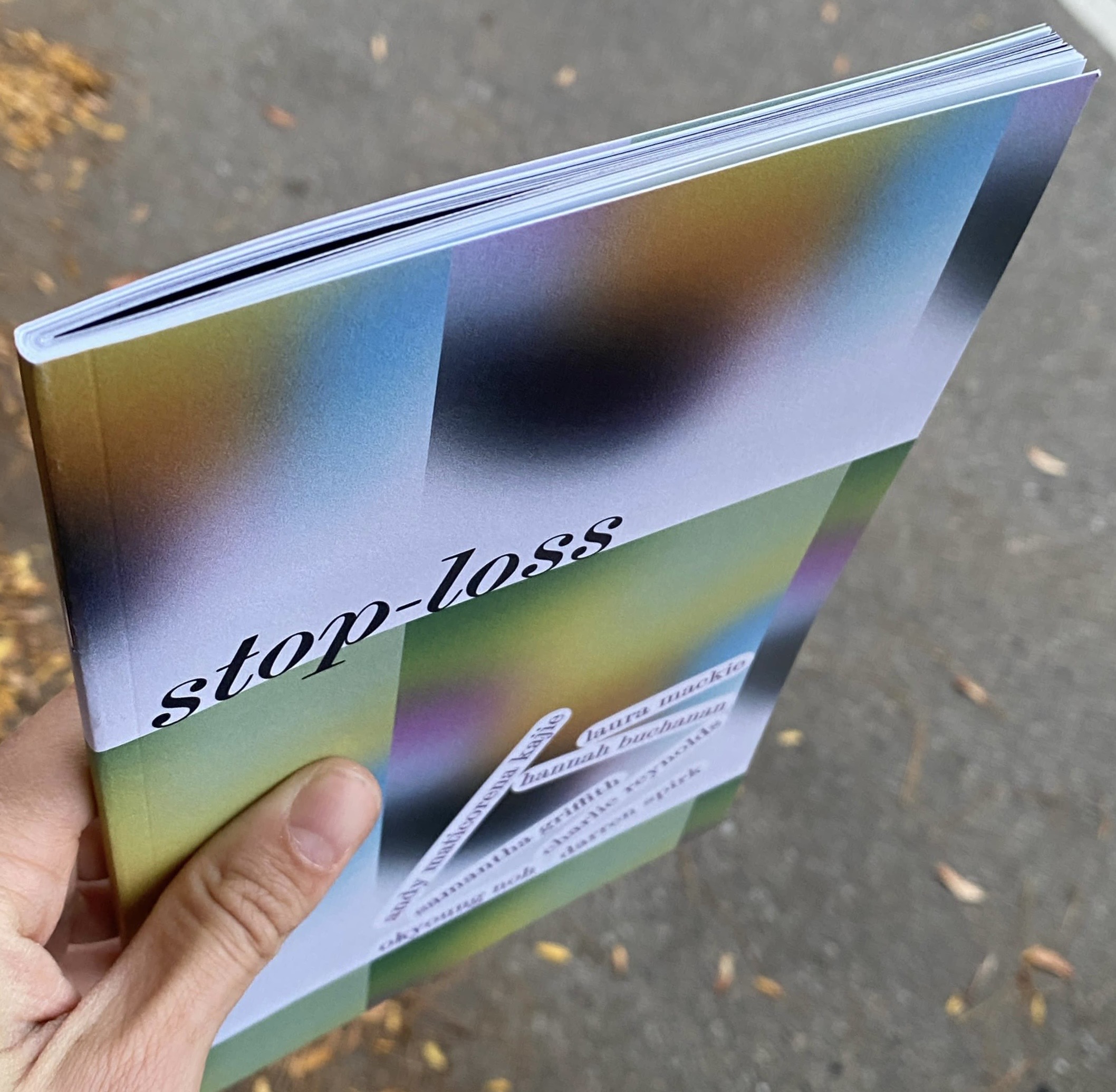
Images of the final result: our printed catalogue.
The catalogue provided a solution to a question many of us have asked: How can art reach beyond institutional walls? What resulted was a new way to experience our thesis projects. The book offers intimacy: it is held, turned, and read at one’s own pace. With a book, viewers/readers can slow down and spend time with the work, allowing extended opportunities for analysis and reflection. It gives people the ability to return to the work again and again even once the gallery exhibition is over. By choosing the catalogue form, we transformed our thesis research into something tangible and shareable, an object that invites participation. In this sense, the artist book is not just a record of artistic practice but an extension of it—a living artwork that continues to grow through its encounters with readers. It is also accessible for those unable to attend the exhibition in person, so people can still experience the MFA artists’ works adjacent to each other. So the catalogue is essentially a portable exhibition - one that can travel, circulate, and live on shelves beyond the Stamps Gallery. This accessibility invites a wider audience into the conversation. Unlike the physical exhibition that lasted for a month, these books would continue to speak long after the thesis show closed. And in this way, the cross pollination and connections made across a range of topics and media are not lost beyond the gallery.
Beyond its mobility, the catalogue also connects with the artists’ communities thematically. Loss is a broad theme that people can relate to in many ways. The featured works address loss across social, cultural, personal, and environmental topics, from gender, memory, genocide, migration, and climate.
Our goal was to design a cohesive catalogue that respected individual voices while maintaining visual unity - thanks to Sam Griffith and Emily Anderson - and conceptual unity - thanks to our contributors. We hoped to produce a physical culmination of how we synthesize and bridge our artistic practices, thoughtfully engaging with each other’s works in creative ways that reflect the MFA program’s goal of producing new knowledge in the arts. And to us, it was a success. Multiple perspectives, mediums, and ideas coexist in one shared publication, bringing together distinct interpretations of, experiences with, and definitions of loss. It is a shared statement about how art can circulate, connect, and transform communities. The project bridges the space between private creative processes and public engagement, allowing emerging artists to enter the wider dialogue of contemporary art while fostering accessibility and empathy among diverse audiences.
Once the catalogue was printed, we were able to display our artist books at the Detroit Art Book Fair. According to one of our team members running the table at the fair, people who attended were impressed by how much our cohort coordinated with each other and appreciated the research, dedication, and attention to detail put into it with the help of the library and our collaborators. We are currently working on distributing copies to our cohort. It would be ideal to continue showing them at art fairs and exhibitions that we are involved in, strengthening our professional development.
We could not do this without the U-M Libraries. While the catalogue was still in progress, our team met with Jamie Vander Broek virtually to discuss our vision for an artist book. Jamie invited us to the library to look through UM’s collection of artist books, which we thought would be helpful to see in-person. We visited the Art, Architecture, & Engineering Library to learn about different layouts and designs of artist books which helped us determine which one best suited our project. We got to sort through other artist books to check out paper types for the cover and pages, as well as book bindings. Many of the books in the library’s collection were kept in their own hand-made boxes, had unique paper, or had interesting fold-outs and pop-ups within the pages. There were also a variety of dimensions of artist books in the collection, from large books to tiny hand-held ones. Jamie did an amazing job explaining how different forms affect the viewer experience and serve different purposes. Looking at these books in person helped us visualize our options and ultimately make our decision on how we would want the book printed within our set budget. And additionally, our entire cohort utilized the library individually in developing our thesis research that informed the exhibition and ultimately the catalogue.
We want to thank the University of Michigan Libraries for their generous support through this grant, allowing us to pay for design and printing. This grant funds strong projects across many disciplines, encouraging students to take rewarding risks and put their ideas into action. Thank you for believing in our project and bringing it to fruition! We also want to thank all of our collaborators, peers, the Stamps Gallery, and all who supported the creation of the catalogue and our thesis projects. We hope that this project will inspire future MFA cohorts to bring their work together as a collective that can reach beyond the streets of Ann Arbor.