
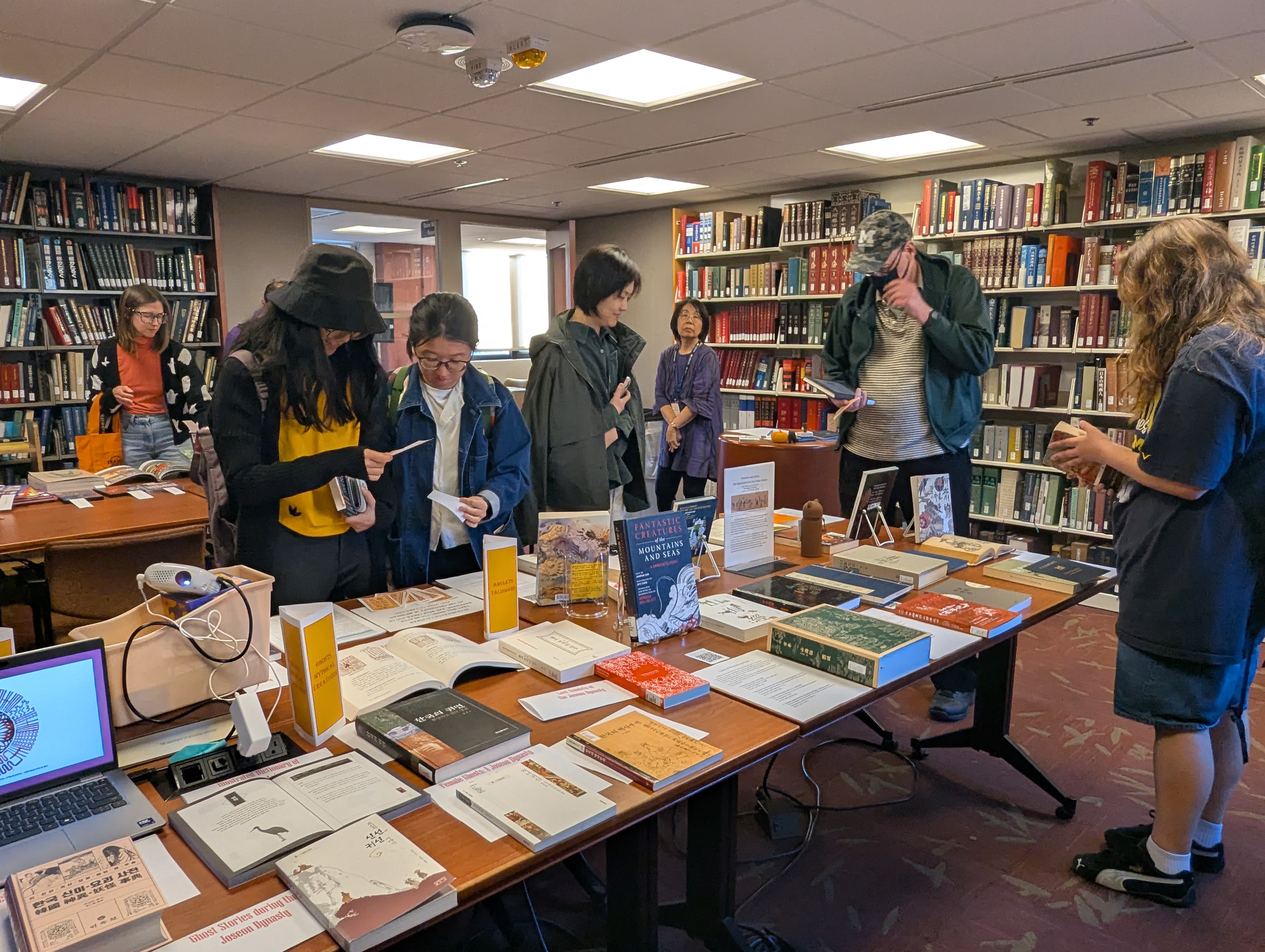
Visitors browsing items on display at the Asia Library Third Thursday event
(photo courtesy of Yung-hui Chou)
One of the most important public engagement initiatives of the Asia Library in the new academic year was our official participation in the Library’s Third Thursday series, a monthly themed open house where we highlight our collections. We hosted three events in Fall 2025 showcasing visually and intellectually inspiring, and even somewhat whimsical, materials on East Asia. Over 150 attendees from across campus and the broader community visited our open houses, perusing items carefully curated by our subject specialists, enjoying relaxing yet informative conversations with curators and staff, and collecting stamps for their Third Thursday passports.
We extend our sincere gratitude to the Library Communication Office and three Centers (Lieberthal-Rogel Center for Chinese Studies, Center for Japanese Studies, and Nam Center for Korean Studies) for their support in promoting our events. Many thanks as well to the Asia Library staff members who kindly volunteered to help with logistics; the events would not have been successful without your efforts. And, thank YOU, our wonderful visitors!
If you missed any of these events but would like to explore the Chinese, Japanese, and Korean items that were displayed, please click the links below.
On a side note, our stamp was informally voted the most beloved Third Thursday stamp. Haven’t added it on your Third Thursday passport yet? Make sure to visit our open houses in Winter 2026!
September 2025:
Panels Across East Asia: The Art of Chinese, Japanese, and Korean Comics
Step into a vibrant world of imagination and adventure through Chinese manhua, Japanese manga, and Korean manhwa. Drawing on the rich collection of East Asian comics housed at the Asia Library, this exhibit invites you to explore their riveting storytelling and unique art styles.
Whether you are a comic book fan or just curious to learn more, this exhibit offers something for everyone. Join the Asia Library staff to explore how Chinese manhua blends ancient aesthetics with contemporary narratives, how Japanese manga became an international phenomenon, and how Korean manhwa pioneers digital storytelling through webtoons. You’ll see how these visual stories reflect the views, hopes, dreams, and everyday lives of their creators and readers across East Asia and the world.
October 2025
Shadows and Spirits: The Supernatural in East Asian Culture
Join the Asia Library staff to explore the mysterious world of the East Asian supernatural. “Shadows and Spirits” invites you to explore the rich tapestry of mythological monsters, strange beings, and ghosts that have played a unique and haunting role in folklore, literature, art, and cinema of China, Japan, and Korea.
Highlighting East Asia’s most spellbinding tales represented in the Asia Library collection, this exhibition delves into how the supernatural embody unresolved emotions, social justice, political sentiments, and cultural symbolism. You’ll encounter the many ways that the stories of the supernatural have shaped the collective imagination and reflected societal fears, hopes, values, and beliefs about the afterlife and the unknown, both in the past and today. In the meantime, beware the turning of the page; something supernatural might be waiting to greet you…
November 2025
Pen, Ink, and Prestige: Nobel Laureates in Literature from East Asia
Explore the remarkable literary achievements of Nobel Prize in Literature laureates from East Asia who have shaped global literature. “Pen, Ink, and Prestige” highlights the transformative works and lasting influence of Yasunari Kawabata 川端 康成 (winning year 1968), Kenzaburō Ōe 大江 健三郎 (1994), Gao Xingjian 高行健 (2000), Mo Yan 莫言 (2012), and Han Kang 한강 韓江 (2024).
Featuring original editions, translations, biographies, and multimedia materials that illuminate the laureates’ lives and literary legacies, this exhibit invites you to reflect on how literature transcends borders and languages, how these groundbreaking writers negotiate East Asian literary traditions in their works, and how they grapple with identity, social change, and the human condition.