Larry Wentzel
Library Blogs
Showing 601 - 610 of 1958 items
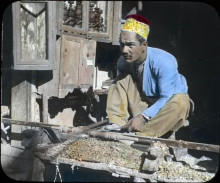
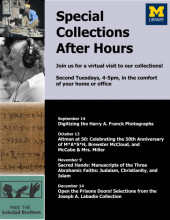
This article reviews how 9,000+ frames of photographic negatives from the Harry A. Franck collection are being digitally preserved.
When examining a selection of rare books that had been requested for a class presentation about the impact of censorship in early modern Spain, I noticed something truly remarkable in one of these books. Our copy of the eighteenth-century edition of Francisco de Quevedo y Villegas’ El Parnaso español y musas castellanas, published in Barcelona in 1703, had been manually, and massively, expurgated by a representative of the Spanish Inquisition, Joseph Pinell, as he himself stated on the title page: Expurgavi ex Commisione S(anc)ti Officii die 8 Aprilii/ Joseph Pinell, Supr(emus). Missionum (I, Joseph Pinell, the highest of delegates, have expurgated it by a mandate of the Holy Inquisition on April 8 1760).
For our graduating seniors who are about to enter the real world, we know it can be a little scary. We’ve put together a list of some books for you to read that can provide some helpful advice. All of the listed books are accessible online!
Sweat, tears, or the sea is a photo-series that comments on the physical space of Asian Americans. I want to capture the tenderness, beauty, and portraits of the children of immigrants to create an identity of what it means for them to know that their family has chosen the path of “sweat, tears, or the sea” in America. I used a collection of 4 images per photo for the individual to be able to know that there is a commonality amongst each of the photos together and that we are all intertwined in the emotions and stories we carry as Asian Americans.
Got some free time on your hands and looking for something to do indoors while you adhere to social distancing? Why not learn a new craft! Over the next few weeks, I'll be highlighting titles from the library's Online Recreational Reading guide, focusing on different genres and subjects each post. Today, I’m going to highlight art, crafting, and DIY ebooks in the library’s collection.
The Digital Public Library of America (DPLA) has collected and made searchable a vast quantity of metadata from digital collections all across the country. The Michigan Service Hub works with cultural heritage institutions throughout the state to collect their metadata, transform those metadata to be compatible with the DPLA’s online library, and send the transformed metadata to the DPLA, using the Combine aggregator software, which is being developed here at the U of M Library.
We are pleased to report about our recent acquisition of the first edition of Alessandro Vellutello’s influential commentary on Dante Alighieri’s Divine Comedy, which was published by Francesco Marcolini da Forlì in Venice in 1544. Undeniably, this edition marked a significant shift in the history of the iconography and reception of Dante’s poem, departing from the previous allegorical interpretations by Cristoforo Landino and Girolamo Benivieni, and challenging Antonio Manetti’s reconstruction of the topography of Hell as described by Dante.
Need to take a break from finishing up this wild semester and unwind? The library has access to a variety of e-books not limited to academic subject matter. Over the next few weeks, I'll be highlighting titles from the library's Online Recreational Reading guide, focusing on different genres and subjects each post. Today, I want to highlight some fiction books published in 2020 that we have available electronically.
•
In the time of COVID-19, I gained an opportunity of nature therapy as a caretaker for the Nichols Arboretum, and I recommend people also document the arrival of flowers and animals or participate in outdoor citizens and community science projects to channel anxiety.
Although the United States only has about 5% of the world’s population, it holds about 25% of the world’s prison population. According to the Prison Policy Initiative, the U.S. currently has about 2.3 million people in a variety of confinement facilities like federal and state prisons, local jails, juvenile correctional facilities, immigration detention centers, military prisons, civil commitment centers, and even state psychiatric hospitals to name some. While women currently make up approximately 10% of the currently incarcerated population, it is important to understand that the rate at which women are being incarcerated has been twice as much as men since the 1980s. Statistics collected by the Sentencing Project show that since the 1980s the number of women who are incarcerated has increased by more than 750%.
We found that many of the current resources speaking about mass incarceration in America are centered on the experiences of men but not as much is said about the experiences of women and gender nonconforming individuals. We believe that when discussing criminal justice reform, it is absolutely necessary to include women and gender nonconforming individuals in the discussion because their experiences precarcerally, carcerally, and postcarcerally, are uniquely shaped by their gender. Referring back to the Sentencing Project, 80% of women in jails are also mothers, most of whom were the primary caretakers for their children before being incarcerated. When women are incarcerated, there are these unique issues such as reproductive health that affect them and their families in ways that men do not necessarily experience. With this in mind, we wanted to create a platform to inform the general public about the experiences of women in the criminal justice system and create a space for those directly and indirectly affected by the carceral state to talk about their lived experiences and areas of expertise. We wanted to place a general focus on health because we believe that our current criminal justice system is a growing public health concern and is often left out of the conversation when we, as a society, talk about access to healthcare, among other things. Millions of individuals are getting locked up everyday for substance abuse offenses when they should be getting better access to treatments and resources to help with addiction as well as other monetary and mental health related concerns. Thousands of incarcerated pregnant women face horrific conditions because they lack any kind of proper access to reproductive healthcare. All of this--and more--needs to be brought to the attention of the public.