
Evyn Kropf
Library Blogs
Showing 1181 - 1190 of 2104 items
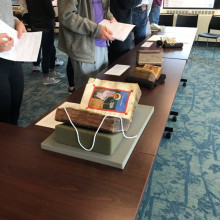
Instruction is in full swing this fall semester! We gave 27 presentations in October alone for 527 participants. Here’s a small sampling of our instruction for the month!

Asia Library will hold a Korean Data Services Workshop in November.

Ancient Roman detective Marcus Didius Falco travels to Germany on a mission for the Emperor Vespasian, to discover what happened to a missing general and to negotiate peace with a powerful Druid priestess. The emperor's son Titus wants Falco out of the way because he has his eye on Falco's girlfriend Helena Justina. Is the barber who Titus sent along with Falco really an assassin? And will Falco have to give up Helena for the good of Rome? Unlike other books in the series, this is more of an adventure novel than a mystery, and it includes plenty of action in the forests of Germany.

A professor teaching a class this semester that frequently meets in the CVGA has been making good use of our Assassin's Creed games in his class, so we've decided to fill in our collection, purchasing some Assassin's Creed titles that haven't been as highly requested in the CVGA, but still add to the series.

Daniela Stockmann, Professor of Digital Politics and Media at the Hertie School of Governance in Berlin, will be the next speaker in the Deep Dive into Digital and Data Methods for Chinese Studies series, October 26-27.
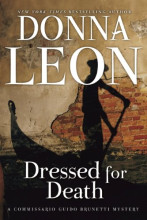
In this third mystery in Donna Leon's long-running series set in Venice, Commissario Guido Brunetti investigates the murder of a transvestite whose face was damaged beyond recognition. It turns out that the victim was one of Venice's most prominent bankers, and Brunetti uncovers a scandal involving financial fraud and illegally rented apartments. Meanwhile, he longs to solve the case quickly to avoid becoming the next victim and to escape the heat of August in Venice and join his wife Paola and teenage children on vacation in the mountains. As usual with Leon, the book features Paola's mouth-watering meals, and Brunetti does some cooking for himself this time.

The CVGA has quite a few new games available for play. We also have a Nintendo Switch available, with several games to go with it. Did you know that there's an RSS feed on our main page that lists all games that were recently added to our collection? Check out our main page for more details.

In line with the University of Michigan Library's strategic plan to support diversity, individuals in the Library Information Technology division started a Diversity Reading Club where colleagues can come together to lean and discuss readings on the subject. The Reading Club has been going for over a year and a half, and we discuss what it is and why we think it works.

Glass Houses is the latest entry in Louise Penny’s long-running mystery series featuring Chief Superintendent Armand Gamache of the Sûreté de Québec, who lives in the tiny village of Three Pines. After Three Pines' Halloween party, a mysterious figure in a black cloak haunts the village green. Two days later, the figure disappears, but the body of a woman, a visitor to Three Pines, is found wearing the cloak. The story of the murder alternates with the trial of the person accused of it, several months later. Meanwhile, Gamache is trying to capture the head of the most powerful drug cartel in Québec. There is, of course, a connection between the drug trade and the murder in Three Pines, but part of the suspense is figuring out what it is.

From September 19 to November 15, the Asia Library (Hatcher Graduate Library 4th Floor North) will be hosting an exhibit that commemorates the 45th anniversary of the Chinese Table Tennis Delegation’s historic visit to the U.S. in 1972, especially to Ann Arbor and the U-M.