
Stories from and about library student employees and interns.
Student Stories
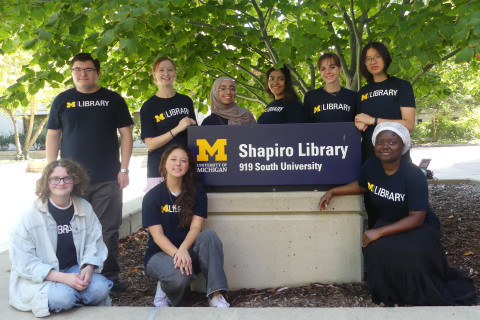
Posts in Student Stories
Showing 81 - 90 of 158 items
•
I always knew my grandfather could speak this odd sounding language, an ancient Spanish dialect that sounded like a mix of Spanish and Hebrew, both of which I was familiar with growing up Jewish in Southern Arizona. I knew that this was his first language, but I did not know much more than that about his heritage–my own heritage–until I became a part of the Michigan Library Scholars. These past few months have allowed me to learn more about my roots than I had ever imagined I would know.

Being a new transfer student, I was intimidated at first by the scope of the University of Michigan and its library, but when I heard that I could have the chance to work on an exhibit based on the Greek War of Independence through the Michigan Library Scholars Program, it was an opportunity I simply couldn't pass up. Not only was my experience one of learning, but also one of fun, as well as growth as a student and a professional.
Each year, the U-M Library hires hundreds of students to work a variety of jobs in the library. These students are an essential part of keeping the library running, and we couldn't do it without them! Some of these students leave us each year to take what they have learned and make a difference beyond U-M. We celebrate our graduates and wish them well in their future endeavors!

A reflection on working in a pair on a multifaceted project in a remote setting as part of the Michigan Library Scholars internship.

Creating the "Hispanofilipino Literature: Translation as Repa(t)r(i)ation" exhibit as part of the Michigan Library Scholars internship.
During the summer of COVID-19, Michigan Library Scholar Yifei Yao contributed to the Askwith International Media Awareness Project by curating an online exhibit that highlights Asian film collections. This remote working experience provided an opportunity for Yifei to learn and grow. Through combining her passion for film and the new professional skills she learned, Yifei became more clear and confident in her career path after graduation.
The Michigan Library Scholars application jumped out at me back in February. I’m a rising junior studying economics & communications with a minor in Spanish, hoping to ultimately work for a non-profit one day. I saw the Askwith project and was immediately drawn to it because the majority of my classes this past semester were on globalization. Slowly I began to understand the necessity of being culturally aware and maintaining diversity in a world where homogeneity is often expected. Knowing I had been confined to my own “single-story,” or was truly only familiar with my home country, became an impediment to my perspective on the global community. The MLS program stood out to me then, and now, because I got to be part of a team of classmates and mentors working to end narrow-mindedness at UM.
•
Michigan Library Scholars intern Sophie Shao provides a glimpse into her experience of creating an animated video about the library's services and resources while working in a remote environment. This project underscores the importance of accessibility with a multilingual lens as well as the need for communication and problem solving in this new era of virtual work.
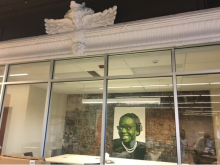
According to The Western Architect, four hundred and fifty million bricks were used in construction in Detroit in 1916. Among the brick buildings featured in this reporting is the Victor Theatre, located near the Ford factory that was, at the time, the largest manufacturing site in the world in Highland Park, an autonomous city in the center of Detroit. Today, this building is the main location of the Ruth Ellis Center, a nonprofit organization providing social and medical services to LGBTQ youth in metropolitan Detroit. While the exterior of the building is now unrecognizable – the façade covered over in the intervening years – certain interior spaces in the theater have been preserved: the detailed proscenium arch framing the stage-turned-conference-room and the upstairs dance hall where, prior to the novel coronavirus pandemic and enforced social distancing, youth gathered to share meals and vogue during the Center’s drop-in hours.
From the beginning of my time as a transfer student to the University of Michigan in the Fall of 2019, I have been interested in both engaging with the transfer community and improving the overall transfer student experience. When preparing for this big transition over the summer of 2019, I was most concerned with adjusting socially and academically to a new school. However, when I actually got here, I found there were many other, more hidden aspects of campus life that I had to figure out on my own. For example: Which buildings require swipe access? Where can I scan a document? What is the “UgLi,” and is it a good place for group work?
I think we don’t often consider how all these little questions and struggles add up to create the transfer student experience. Transfer student success is often measured by quantitative academic markers; students themselves are concerned with adjusting academically and socially. I’m sure I’m not alone in saying that concerns about how to use the library as a transfer were far from the first thing on my mind. So, when looking for social science research opportunities this fall, I was intrigued by a position that entailed analyzing the specific library needs of transfer and commuter students. I saw it as an opportunity to engage with the transfer student experience through the unique, and often undervalued, lens of the library.
Ultimately, this interest led to me joining the Library Research & Evaluation team as a Research Assistant, as part of the Library Engagement Fellows Program. Through this position, I was able to utilize and strengthen my social science research skills through a project I am personally invested in and passionate about. Additionally, this position exposed me to library functioning and the specific resources offered by the University of Michigan Library.