
Anecdotes and other notes from the U-M Special Collections Research Center.
Beyond the Reading Room
Posts in Beyond the Reading Room
Showing 371 - 380 of 414 items
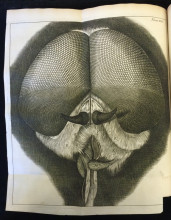
This superb engraving depicts what the seventeenth-century English scientist, Robert Hooke, observed when exposing the head of a grey drone-fly through the lens of a microscope. The greatest section of the head was nothing else but two large “protuberant bunches,” mostly covered by thousands of tiny hemispheres arranged in “triagonal order”.
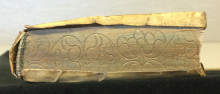
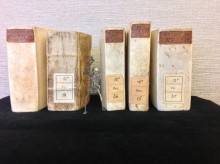
This recently acquired edition of two medical commentaries by the sixteenth-century Italian doctor, Leon Roganus Caietanus, is bound in limp vellum with bevelled boards, and the gilded edges of the text block have been expertly decorated, or gauffered, with a special tool.
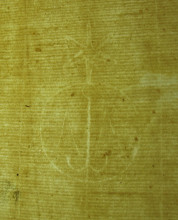
This Wednesday's watermark feature: Anchor motifs in watermarked papers from the Islamic Manuscripts Collection
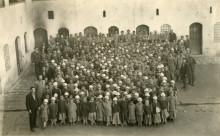
"Now or Never": Collecting, Documenting and Photographing the Aftermath of World War I in the Middle East. This exhibit explores the role of the U-M archaeological expedition (1919-1920), led by Professor Francis Kelsey, as witnesses of the chaos and destruction in the Near East following Germany's surrender to the Entente forces on November 11, 1918.
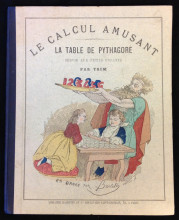
We are excited to report about a recent acquisition for our fast growing collection of Children's Literature. It is the first edition of Le calcul amusant (Paris, ca. 1862), a truly entertaining book designed to teach French kids multiplication through colored illustrations and rhyming couplets.
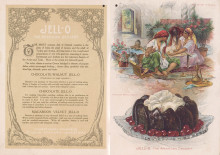
Talk and reception to celebrate the upcoming online exhibit "Jell-O: America’s Most Famous Dessert At Home Everywhere." Dr. Nicole Tarulevicz of the School of Humanities at the University of Tasmania speaks at 5:00 p.m. Using materials drawn from the culinary ephemera holdings of the Janice Bluestein Longone Culinary Archive at U-M Library, the exhibit explores how the Jell-O company’s early 20th century advertising used depictions of the exotic to sell the product to Americans.
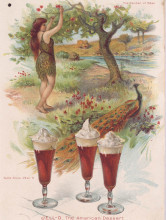
Early 20th century advertising materials for Jell-O contain striking representations of age, race, class, gender, nationality, regionality, and other vectors of identity; whether self-defined or other-imposed. In January, we’ll unveil a digital exhibit, guest curated by Dr. Nicole Tarulevicz, on depictions of the exotic in early 20th century Jell-O advertising. There will be an exhibit opening and reception, with a talk by Dr. Tarulevicz, January 12th, 4:30-6pm, in the Hatcher Gallery
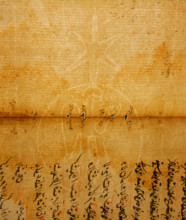
This Wednesday's watermarks feature: angel motifs in one of the papers of a 16th century Turkish manuscript from the Islamic Manuscripts Collection.
We may sound playful by making a skeleton pop out from a book, but for centuries images like this one, as found in the printed page, were a serious warning of the imminence of death. For instance, these frightening illustrations were common in the published works of the seventeenth-century Jesuit preacher Jeremias Drexel.
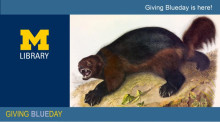
All gifts to the library on Giving Blueday help fund our acquisition of John James Audubon's The Viviparous Quadrupeds of North America, a magnificent collection of 150 hand-colored lithographic plates.