
Project DOR background
Since 2024, the development team for Project DOR has been hard at work designing and building a sophisticated preservation repository. This new digital object repository (DOR) will first be used to preserve the digitized materials for Digital Collections. To learn more about the new repository technology, read Delivering exciting upgrades to digital collections through Project DOR.
Project DOR is improving the way we preserve digitized materials, but it’s also enabling us to rebuild and improve the user experience of our over-20-year-old web application that allows users to discover and access digital collections.
A long history of Digital Collections user research
You may recall that we already put a lot of work into improving the UI for Digital Collections from 2021-2024 (read our audio and moving image collection evaluation post and text collection evaluation post to refresh your memory).
In those recent evaluations of the UI redesign for Digital Collections back in 2023 and 2024, we confirmed concerns that there were multiple usability issues which could not be addressed by UI improvements alone — the legacy back-end technology, DLXS, has technical limitations that negatively impacted users’ experiences discovering and accessing digital collections. This was one of many reasons that the Project DOR team was assembled.
The previously mentioned UI redesign work was important and valuable, and the vast majority of those changes will be preserved. But, with Project DOR, we can do far more to improve the user experience of Digital Collections.
As the User Experience and User Interface Designer embedded in Project DOR, it is my responsibility to develop and test new interface designs that carry over all our insights and recommendations from the previous five years of research.
We started planning UI updates by conducting user research regarding potential solutions for one of the biggest issues facing users: difficulty searching for and discovering materials.
About the discovery research
While UX research and design will continue through June 2027 and beyond, we completed one study on search enhancements in 2025, focused on potential GenAI development opportunities. We were inspired by Northwestern and Harvard Libraries, which recently released new digital collections platforms that incorporate cross-collection searching with optional GenAI enhancements to search results. We wanted to gather reactions to different levels of AI presence.
- High AI presence: Chatbot-style, completely AI-generated narrative response
- Medium AI presence: Short statements generated by AI that describe why a result is relevant to your search in addition to existing metadata
- Low AI presence: Machine learning is used in the background to surface more relevant results for semantic searches, but no AI-generated text appears in the user interface
Study design
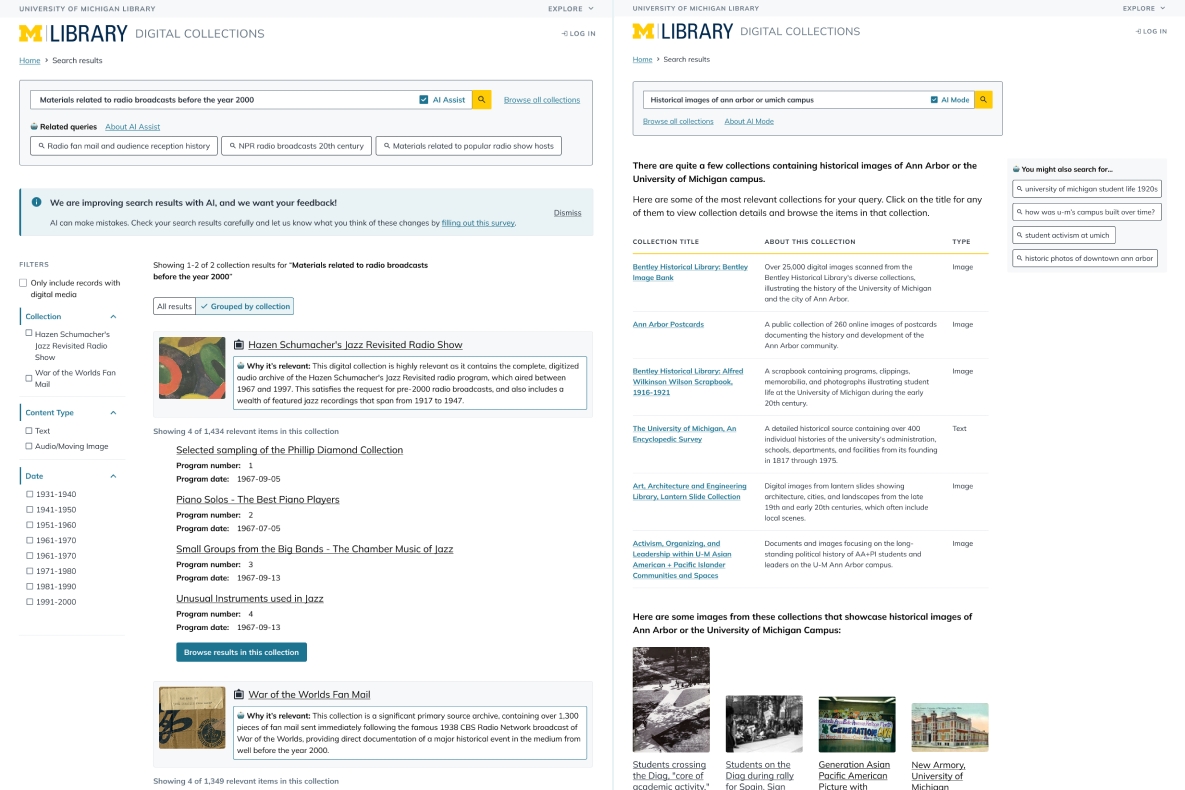
Examples of the GenAI search result interfaces we built in Figma
As most technologists know, chatbots are not easy to build. We wanted to avoid putting developer resources into building AI technology without knowing if users were interested in an interface like that for Digital Collections. We designed a low-impact evaluation using no-code, minimally interactive prototypes with text generated by an existing large language model (in this case, Google Gemini on U-M’s institutional license). This approach is similar to the Wizard of Oz method — using a lil’ UX magic to get valuable information without massive technical effort.
We recruited participants for this study who were active users of digital collections, including staff, faculty, and students in various academic units. The study included a brief interview to gather insights about personal AI use, and then I facilitated a structured usability test with the prototype to gather reactions to the three different levels of AI presence.
Major findings
- Multiple participants expressed a high level of concern about GenAI being incorporated into search results for Digital Collections. They shared reasoning including:
- Potential bias & hallucinations, which may be particularly difficult for users to detect when coming from an authoritative source such as a university library
- Hindering student learning, a growing concern in academic institutions
- Environmental concerns
- Participants expressed a high level of appreciation for the planned improvements to searching in digital collections, as searching continues to be a major source of frustration.
- In reaction to our design for new cross-collection search functionality, some participants expressed a desire to retain collection context in all views to effectively communicate the importance of the human-organized collections.
- The majority of participants expressed that if GenAI is incorporated into any system, it should be turned off by default to allow interested users to opt-in.
- All participants highly appreciate transparency and control when it comes to integrating AI into any system.
What happens next
We are prioritizing semantic search functionality, cross-collection searching, and improved filtering and sorting rather than focusing time and energy on experimental GenAI features. We will reconsider incorporating GenAI into search results at a later date, following library-wide guidance on ethical technology adoption. More details about planned updates for Digital Collections will be shared in our next blog post.
There will be more opportunities for colleagues to try out the new interface and provide feedback over the next year. If you would like to be notified of future user research opportunities, please email Emma Brown at emkbrown@umich.edu to be added to our list.
Acknowledgements: Thanks to the Project DOR team: Roger Espinosa, Sam Sciolla, Greg Kostin, Noah Botimer, Jessica Venlet, Bridget Burke, Bill Dueber, Kat Hagedorn, Chris Powell, Rob McIntyre, John Weise, and Sebastien Korner.