
Craig Smith
Posts tagged with Research
Showing 21 - 30 of 37 items
This blog post presents how the use of multiple streams of data benefited two recent U-M Library studies. For example, one recent study merged survey data, U-M human resources data, and Library document delivery data to provide a very rich picture of how diverse groups on campus use and experience the Library’s document delivery service. Some advantages of joining multiple data sources in assessment projects are discussed in the context of the two example studies.

A project team charged with providing staff training activities approached the project assessment with an iterative design lens, allowing for responsive and timely development of multiple opportunities for staff engagement around organizational and personal change. The team tried out different assessment techniques related to the opportunities offered.
What does it mean to evaluate assessment practices through a DEIA lens? Sheila Garcia, Resident Librarian in Learning and Teaching, shares her personal journey applying a critical lens to her capstone project that centers the experiences of undergraduate language brokers.
When planning an assessment project in the Library, one important step is to consider whether your project should be vetted by the Institutional Review Board (IRB) at U-M, a committee that ensures studies with human subjects are ethical, that subjects are protected from unnecessary psychological or physical risks, and that subjects are participating in a fully informed, voluntary manner. This post details when your data collection may be subject to a full IRB application and review process.
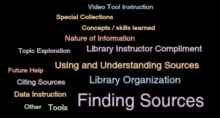
Assessing library impact on student learning is essential for demonstrating libraries’ integrated value and commitment to higher education. In 2018 the author investigated faculty perceptions of student learning in library instruction sessions, and as a result, revealed that faculty observe enhanced learning when their students participate in library instruction opportunities.
In this post, the author describes how they used the assessments of a revised library curriculum for the College of Pharmacy to demonstrate the value of the sessions for students, and to stimulate the creation of a new learning object - a game - to improve student learning.
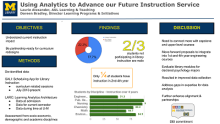
The 2018 Library Assessment Conference (https://libraryassessment.org/) brought together a community of practitioners and researchers who have responsibility or interest in the broad field of library assessment. This post recaps the conference poster content presented by Laurie Alexander and Doreen Bradley about how analytics advanced the Library's internal understanding of the course-integrated instruction provided by Library staff.
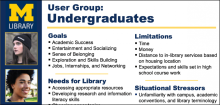
The first post ("Personas: A Classic User Experience Design Technique") in this 2-part series described what personas are and, generally, how to create them. I closed with some cautions about ways personas might come out less than helpful – creating flat, overloaded, or fake (unresearched) personas. The second post presents our persona development for a specific website project.

Personas are employed in user experience design work to help design teams create or improve systems, spaces, and services with targeted populations in mind. Libraries use personas as archetypes to maximize effective library user experiences. This is the first of two posts about the creation and use of personas in the U-M Library.

Not everything a library wants to know is available via web-scale analytics tools such as Google Analytics. Often, custom instrumentation and logging are the best way to answer usability and analytics questions, and can offer better protections for patron privacy as well.