
Bohyun Kim
Posts tagged with metadata
Showing 1 - 10 of 10 items

The University of Michigan (U-M) Library’s Library Information Technology (LIT) Division has collaborated with the Institutional Data Initiative (IDI) at the Harvard Law School Library. This joint pilot project reprocessed the U-M Library's Proceedings of the University of Michigan Board of Regents digital collection, which consisted of more than 55,000 scanned pages from 71 volumes, using the latest AI technologies. The team has produced three datasets with AI enhancements for better accessibility, browsability, and findability. The datasets, processing pipeline, and technical report are all openly available without restriction at the U-M Deep Blue Data Repository, ICPSR, Hugging Face, and arXiv for researchers and scholars worldwide.

In this interview, Dr. Kathy Klinich, research scientist at the UM Transportation Research Institute, describes their research and why they decided to share their data sets entitled "Finite Element Models of Wheelchairs and Associated Components to Support Wheelchair Transportation Research" and "Evaluating Wheelchairs for Potential Use as Aircraft Seating: Test Data."
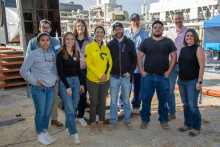
In this interview, Dr. Jenna Stolzman, a recent graduate from the Mechanical Engineering PhD program describes their research and why they decided to share his data set entitled “Dataset for: Effects of crosswind and shroud geometry on performance of low-flow, non-assisted flares,” in Deep Blue Data.

In this interview, Dr. María Natalia Umaña describes her research and why she decided to share her data set entitled "Dataset of wood and leaf traits of tropical dry forests seedlings and adults" in Deep Blue Data.
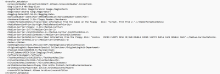
In 2024, The U-M Library Digital Preservation Lab uncovered an almost decade-old mistake in our metadata workflow. Luckily, we were able to use this as a learning experience to think about how we can anticipate future changes to metadata formatting standards in the digital archaeology space.

In this interview, Dr. Amir Salaree (Research Fellow at the Department of Earth and Environmental Sciences) describes his research and why he decided to share his data set entitled "Supporting Data for Solving a Seismic Mystery with a Diver's Camera" in Deep Blue Data.

This post highlights one of the new members to the DBRRDS team! Peter Cerda is Data Curation Specialist for Workflows and Big Data.

In this interview, Dr. Adam Rountrey is the Research Museum Collection Manager (Vertebrates/Plants) and 3D Specialist at the University of Michigan Museum of Paleontology (UMMP) describes his research on hormone levels in woolly mammoth and African elephants tusks. Several CT scans of these specimens are available in Deep Blue Data.
The Digital Public Library of America (DPLA) has collected and made searchable a vast quantity of metadata from digital collections all across the country. The Michigan Service Hub works with cultural heritage institutions throughout the state to collect their metadata, transform those metadata to be compatible with the DPLA’s online library, and send the transformed metadata to the DPLA, using the Combine aggregator software, which is being developed here at the U of M Library.
Paul Schaffner gives an introduction to batch editing metadata using tools that have worked well for him as part of his role in the Text Creation Unit (TCU) within the University of Michigan Library's Digital Content and Collections Department. The instructions and guidance provided, while originally aimed at cataloguers, can be utilized by anyone by following along with Paul's instructions and referring to the suggested resources and links within the article.