
The Digital Library eXtension Service or DLXS, has been providing access to digital collections at U-M Library for over twenty-five years. At this point, the technology has become outdated, cumbersome to maintain, and limits opportunities for creating new features.
In the past few years, we have made improvements to digital collection interfaces but we have long had a goal to completely replace the current platform, DLXS, to achieve all of our improvement goals. (See our digital collections ecosystem blog post for more on our entire landscape.) We’ve recently introduced a new repository project called Project DOR, a multi-year project initially dedicated to the development of a new repository for digital collections. We’ve written a blog post introducing the project and its technical components.
What are Digital Collections at U-M Library?
Digital collections are archival materials and original sources — like books, manuscripts, letters, periodicals, poetry, drawings, photographs, and oral histories or radio recordings — that have been digitized and preserved, and made available in a custom-built searchable and browseable interface.
Most digital collections at U-M are created for library and archives units (eg, Bentley Historical Library, William L. Clements Library, Special Collections Research Center) as well as from our on-campus specimen museums and other U-M units. They are collected and preserved to support the research, instruction, and scholarship mission of the University of Michigan.
The Library’s Digital Collections Service team stewards over 200 collections at U-M Library. We’re really excited about the current opportunity — to replace our Digital Collections software and interfaces with a new platform that will allow us to deliver critical upgrades to provide better access and preservation.
Our expectations for Project DOR and Digital Collections
As mentioned, our current technical infrastructure is old enough that it doesn’t allow us to provide new features or functionality easily, and we’ve long had a goal to develop a new repository that can support improvements in a range of areas including improved searching, navigation, and administrative support. We expect Project DOR to provide the following improvements over time.
Improved searching
Improved search functionality is among our highest priorities during the current phase of Project DOR. One of the most exciting improvements will be the ability to search and browse across all our digital collections. Currently, you can’t search all our items in our list of digital collections and we get a lot of questions about why this isn’t possible! Through Project DOR, we will reimagine functionality in our “all collections” (aka A-Z) list to support searching all items in all collections.
Additionally, we will be treating the words added to a search box as keywords, instead of as a literal phrase (which is currently the case). We will also be making it possible to search the metadata and full-text of our textual materials together. Our different indexing engine will enable these functionalities.
See our recent blog post about the potential for integrating Generative AI functions for searching digital collections.
Better navigation and use of pages
Currently, when navigating many text collections, end-users are faced with an interstitial “table of contents” page that lists all the pages in a text. When we improved the user interfaces in the past few years these pages became one more click that end-users had to make to get from their search or browse results to the content in the image viewer. We plan on removing those, where possible, for a better user experience.
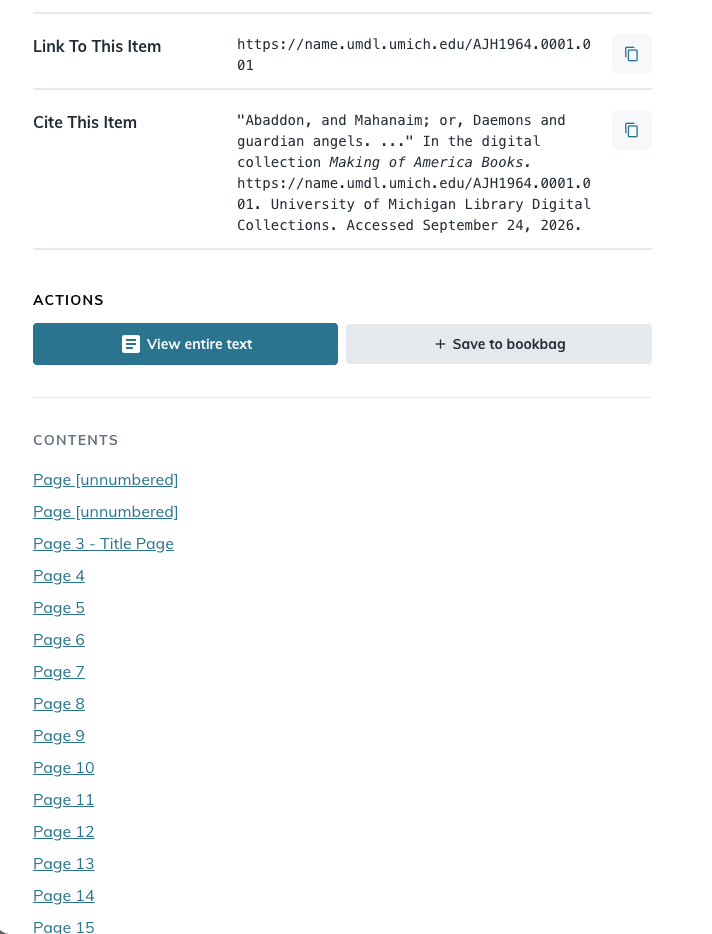
Table of contents page – listing all pages in a text – used in some text digital collections.
In addition, because of original technical constraints, we currently limit end-users from downloading more than 10 pages of a document, and more frustratingly, we choose which 10 pages those are! In the future with Project DOR infrastructure, we will make it easier to choose the set of pages you’d like to download (with limits on the total number of pages chosen… to make our servers happy!).
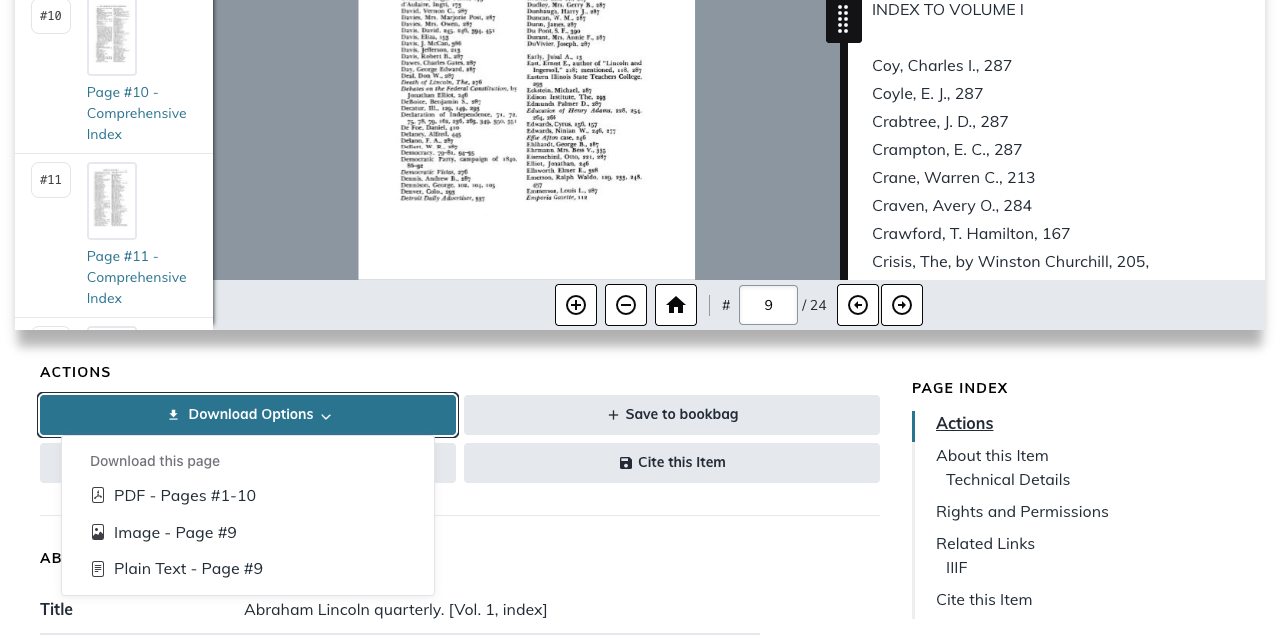
Dropdown selected to show request of download of 10 pages of the text.
Internal administrative support
While this is not end-user facing, we will benefit internally from a more streamlined collection management tool for storing and reviewing digitized objects and their metadata, as well as a more efficient pipeline for ingesting and versioning materials, including an embedded OCR engine for textual materials. See more about these aspects of DOR in this blog post, including how we’re working to meet U-M digital preservation standards and protocols.
What’s not going to change
There are many improvements we’ve made in the past several years that we will not be throwing away! We did a lot of work on the improvement of our user interfaces in the past few years, and that will remain the same. End-users and partners have been successfully using these new interfaces for several years, and multiple user studies have verified the interface changes are an improvement.
We will continue to serve images, audio and video through our existing customized viewers. We will also continue to remediate accessibility issues, as we remain committed to improving the user interfaces to comply with ADA Title II and WCAG.
Looking forward
The Project DOR team aims to have the first version of the new repository functioning with a couple collections migrated and available in the new system by June 2027. At that time, some of the updates noted in this post will be available, and other improvements and features will be worked on at a later date. Full migration of digital collections from the current platform (DLXS) will be ongoing after Project DOR is complete. We will share more about Project DOR improvements and features in future blog posts as the work progresses.
We’re looking forward to continuing to work with our content partners in the same manner as before, even as some of our internal workflows will change and we may have some different requirements. We will always be available for questions regarding metadata and objects, needed functionality and features, accessibility concerns, and other vital aspects of digital collection creation and maintenance.
The Digital Collections Service is truly looking forward to seeing these improvements using our new repository technology. We expect to follow up this blog post with another one illustrating improvements as they are made available.