
My description of myself since starting college often revolves around my major, minor, and hometown. I have grown used to saying, “Hi, I’m Nicole, a History and Philosophy major from Miami.” While this is certainly an important part of my identity, it glosses over a core characteristic and interest of mine by which I truly define myself: my love of baking and cooking. I have worked across bakeries, both in my hometown of Miami Beach and in Ann Arbor as a pastry cook, decorator, and more. My love for food, local ingredients, and understanding how food is made originated at a very young age and has only grown with time. Keeping this love close to my heart, while I pursue my academic interests means that my days in college often consist of going to my history courses—loving every second of them—and then coming home to bake bread, pasta, tarts, and countless other desserts and pastries for me and my roommates.
When I saw the Michigan Library Scholars Paths to Plate project description, I was shocked that there was a project so well aligned with my niche interests. Combining history and food together, and doing research in my newfound home of Michigan sounded like a perfect way to learn more about my passions not as separate aspects of my life, but as one.
Through this project, I explored how immigration has shaped Michigan’s food landscape over time. With my co-intern Richie and our mentor Autumn Wetli, I focused on gathering information through digital research and through in-person archival work at the Special Collections Research Center. This research helped develop an understanding of how Native populations and European, Asian, and African immigrants in Michigan shaped one another through foodways and agricultural and cooking practices, forming a diverse population and melting pot of cultures in Michigan.
I started my research process by gaining contextual information on the broader history of immigration to the United States and then delved into Michigan’s history more specifically. When looking at Michigan in particular, I made sure to emphasize Native American history in my research and the effect settler colonialism had on these populations and their foodways. This laid the groundwork for the rest of the project and determined the direction I took with my research.
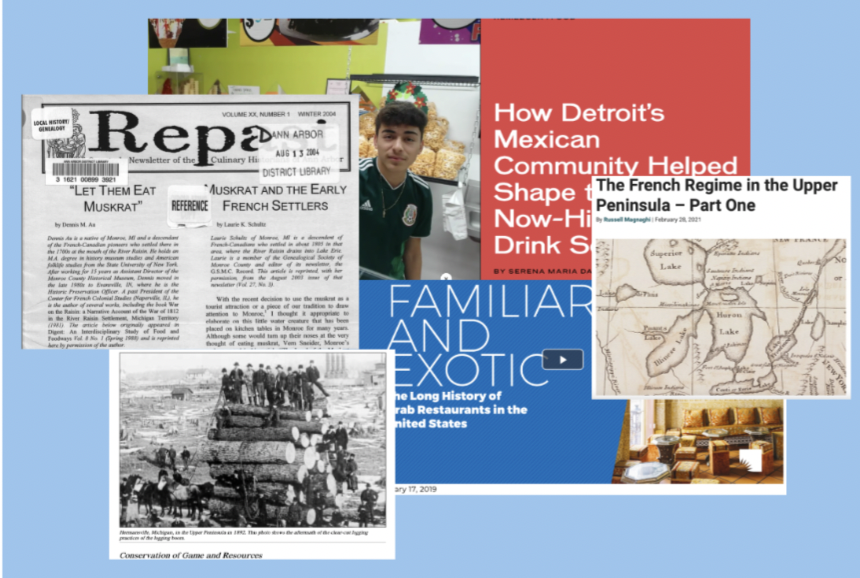
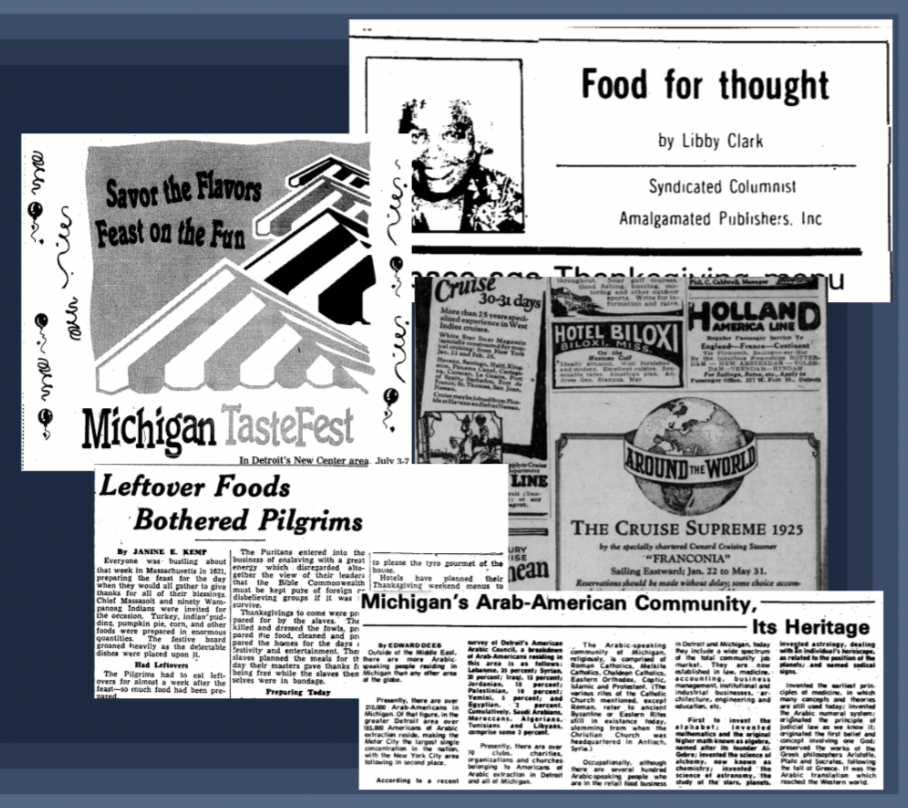
The next step was to use the seemingly simplest research method I had at my fingertips which actually proved to be the most useful and effective: Google. While archival databases are great, I found that with Google, I was able to find a wealth of information, various old newspapers, websites, academic articles, oral histories, videos, and more. The topics covered across these sources ranged from Mexican foodways, to French settlers, Native American and British mingling, and Arab and African influences. The variety that the searches displayed put into perspective how diverse and complicated Michigan’s history with food and immigration is, a realization that set the tone for the rest of the research process and piqued my curiosity even more.
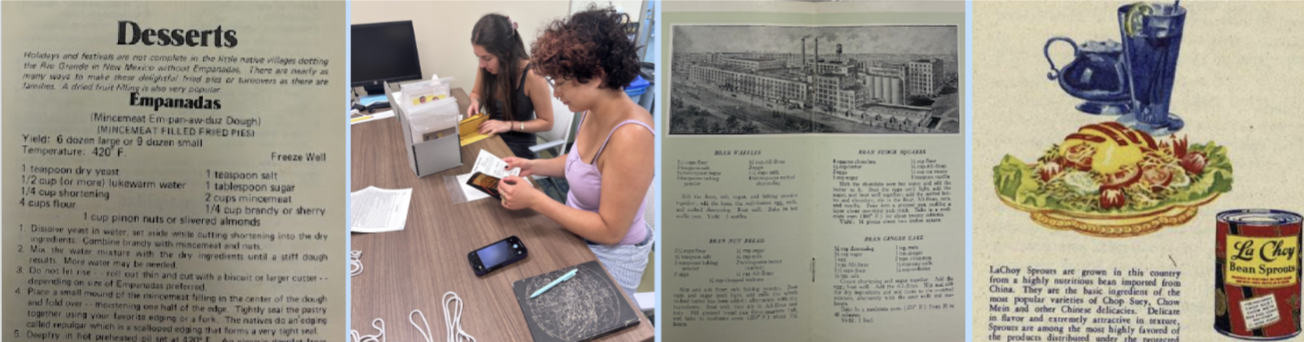
After looking through the historical newspaper databases, we took our first trip to the Special Collections for in-person archival research. While there, Richie and I looked through countless menus, recipe books, flyers, pamphlets, and more. All of the image and information gathering we completed there was very helpful for envisioning the final exhibition and gaining a better understanding of how the way food is spoken about has changed throughout the years in Michigan. One example I found especially interesting while at the Special Collections was the way “empanadas” were described in a cookbook on Mexican food. As seen in the image below, they are called “mincemeat filled fried pies,” rhetoric which emphasizes the Americanization of other cuisines and food staples as well as the combining of different cultures in Michigan foodways.
While some projects have a concrete goal at the end of the internship, our work will not be exhibited for another year, making our work more about building a foundation for future researchers to use, and continuing to gather information, rather than showcasing a final product.
Throughout the research, there were definitely some challenges, but rather than hurting the process, they actually opened a lot of doors and taught me to find creative solutions and think outside the box. The main challenge arose from the very specific topic that we were researching, which made it very difficult to find a broad range of sources. At first, this was daunting as I went through the short list of articles and websites available online. However, with the help of Richie and Autumn, I worked through this challenge by taking advantage of how narrow the scope was, rather than thinking of it as an obstacle. When there is such a wealth of work on a subject, it is often difficult to fully analyze it all. The minimal amount of information, while limiting, allowed me to really dive into each article, paper, and image.
Before starting this project, I did not know much about Michigan’s history, foodways, or the extent of its cultural and ethnic diversity. Nearing the end of this research process however, I have grown so much more knowledgeable about the state of Michigan, not just in its cuisine, but its geography, politics, and settler history. While our work on the Paths to the Plate project is coming to a close, the project is not complete. Richie and I are the first step in a long process of research and writing. We worked to lay the groundwork and research foundations for others to take on, polish, and carry out and I cannot wait to see how the next set of researchers takes this project and the final exhibition!