
From October 2025 to April 2026, I worked alongside my amazing project partner, Katherine (Kate) Jeong, on Exploring Anime: Collections Research and Outreach Programming under our wonderful supervisor, Karen Reiman-Sendi, as part of a Library Student Engagement Fellows project. Our goal was to understand the scope of the University of Michigan Library’s anime collection and raise awareness of it to students and visitors of the library through outreach and programming events. Furthermore, we wanted to showcase that, as the University is a research institution, anime is an expansive genre worth analyzing in a cultural, stylistic, and literary context.
I’ve enjoyed anime for as long as I can remember. Doraemon, Crayon Shin-Chan, Nintama Rantarō, Laputa: Castle in the Sky, and Kiki’s Delivery Service were instrumental to my childhood. I’d sit in front of my grandmother’s old television during the scheduled network times, sweating in the muggy Japan summer, licking ice cream and gazing at the colorful images flying across the screen. My mother would buy VHS tapes (we didn’t have a DVD player yet) of my favorite special features and films, and when we returned to the U.S., she’d put them in and adjust the time stamp to start exactly where I wanted, skipping the parts I disliked. Doraemon’s imaginative inventions, Shin-Chan’s silliness, Rantarō’s hard working attitude, Sheeta’s selflessness, and Kiki’s determination all contributed to my growing up.
Yet, through high school and half of college, I grew indifferent to anime—at worst, I was repulsed by it. Anime seemed more of a commodity and stereotype rather than a cultural and artistic medium, and I struggled to find the pleasure in watching it and talking about it with others. So, when I saw this student engagement fellow posting, I was drawn to the goal of understanding anime from a research perspective and showing the depth and variability anime had to offer. In addition, I had attended a STEM magnet high school and loved the research designs and methods, but I pivoted my interests to literature and creative writing in college. Thus, I saw this as a perfect opportunity to intersect my love for research and literature/media.
One of our project deliverables was creating an inventory of anime film and television titles currently available in the Askwith Media Library and suggesting recommended purchases based on the gaps identified in the collection through WorldCat, personal knowledge, and scholarship on anime. I checked out Anime: A History by Jonathan Clements; Anime by Colin Odell and Michelle Le Blanc; and The Ghibliotheque Anime Movie Guide by Michael Leader and Jake Cunningham from Hatcher Library to get some ideas of purchases for the library. Yet, I was overwhelmed by the amount of information about anime there actually was. Anime strictly from Japan? Anime from the U.S.? Anime from other parts of the world, like China or South Korea? There were so many facets that I hadn’t realized existed in the scope of anime, since most of what I was familiar with was Studio Ghibli and the children’s anime I knew growing up. I felt imposter syndrome shrouding my mind, and every time I opened my laptop to work on this project, I felt like I had walked in circles, arriving at the same spot when I decided to stop for the day.
I realized that my idea of research was mainly based in STEM, where there’s a specific methodology and experimental formula to perform in a lab in one or two class sessions, then discuss findings based on those results. Yet, for this project, the research spanned across months of literature reviews and varied library collection analyses rather than a few days for hard-and-fast numbers and statistics. I had to shift my expectations. Perhaps research is walking around in circles, arriving at similar conclusions even after finding more information. Karen really helped me understand that nothing about research is linear, and any conclusion we reach is still a conclusion at the end of the day. That’s what I’ve always enjoyed about literature, how many different interpretations one could come to from a single subject. I needed to remind myself that this anime project was no different. It would be one part of a multitude of anime-related research, and perhaps I could bring another perspective into it.
Based on the library’s current collection, we also created an annotated bibliography of quintessential anime available through the library, which we separated into two sections: Stateless anime, and Anime Based in Japanese Culture and History, to best capture the main themes and patterns in anime. I watched a lot of anime this past semester, mostly new to me but also familiar: the original 1963 Astro Boy with my parents in our living room, who sang along to the theme song; Sailor Moon R with my oldest sister, who explained every bit of lore about the characters; Nausicaä of the Valley of the Wind with my friends, who had only seen the most famous Studio Ghibli films; Detective Conan with my other older sister, with whom I eagerly deduced the murder suspect. Beyond providing valuable research information to the library, I also expanded my own and my loved ones’ anime repertoire and appreciation.
Yet, Kate and I still needed to expand this interest in anime and awareness of the library’s collection to the greater campus. Through our environmental scan and competitive analysis we performed from January 2026 through April 2026, we found that not many university libraries or general university institutions held anime events. Thus, in late February, we hosted an event entitled, “Blind Date with an Anime,” inspired by the Library Student Ambassadors’ Blind Date with a Book, intended for all visitors, whether they were familiar with anime or not, to explore the media the library offered. We wrapped 15 anime DVDs and Blu-rays and tabled in the Shapiro Library. Everyone seemed enamored by the mystery of the wrapped titles and had a blast guessing which titles hid behind our blurbs. Even though many visitors told us they didn’t have DVD players, they were still interested in physical media and were intrigued to learn about the Askwith Media Library’s Viewing Station. Since we had found that many library users weren’t familiar with the Askwith Media Library or its resources, I found it majorly successful to be able to raise awareness about it to students.
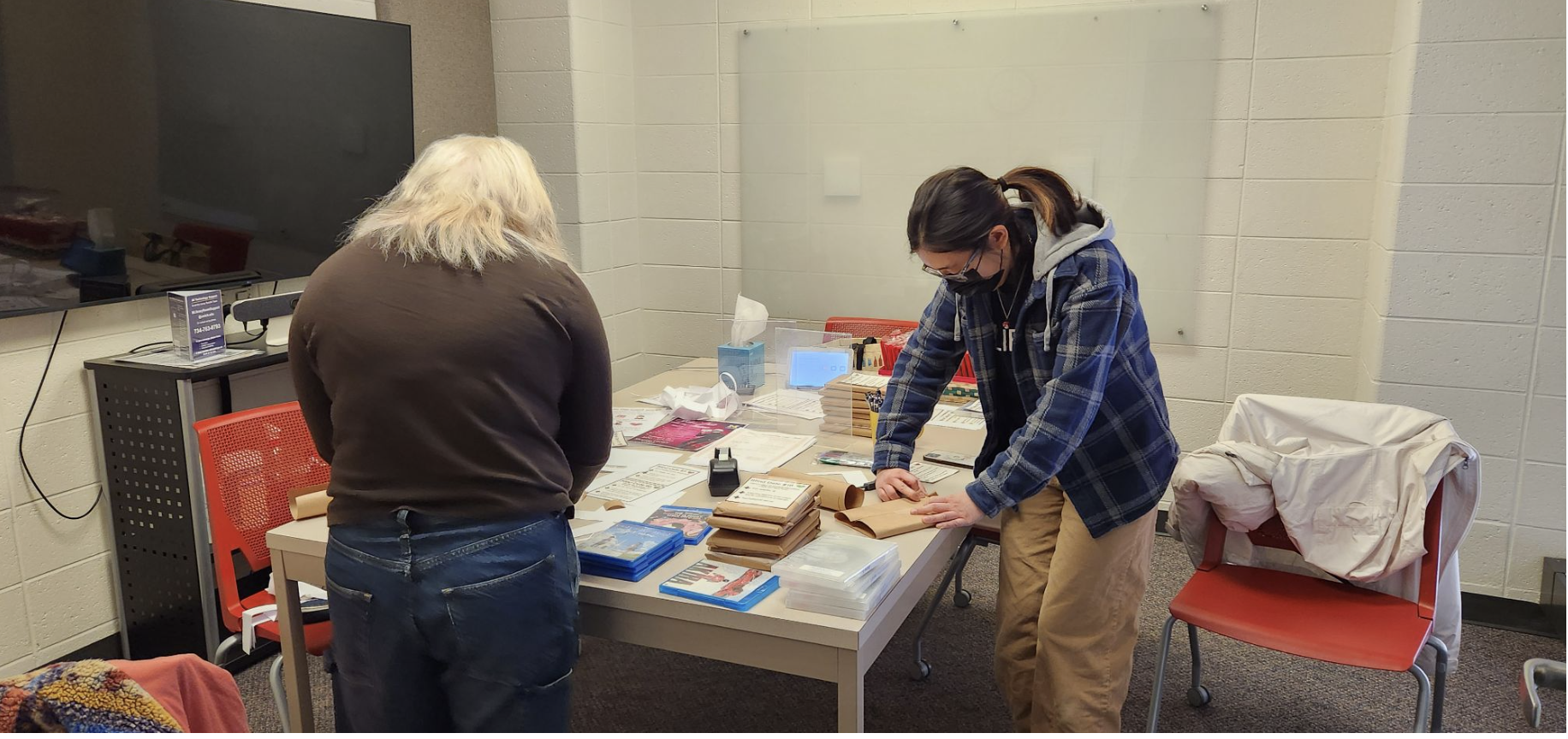
Kate and I wrap DVDs and Blu-rays
We then hosted the “Animanga Stress Busters” event in early April 2026 catered toward those familiar with anime, like us. We provided materials for coloring anime characters and scenes, and button making with the gracious help of Library Student Ambassadors. We also screened Liz and the Blue Bird by Naoko Yamada, a quiet spring anime about the deep connection two girls have through music. The animation was absolutely stunning, and the relationship between the girls captured me since the moment they came on screen. I, along with our visitors, watched intently while coloring pages with Doraemon or Demon Slayer as they played their concert and professed their deep love for each other. I also made some buttons from The Guy She Was Interested In Wasn’t A Guy At All manga, which I must read in the future!
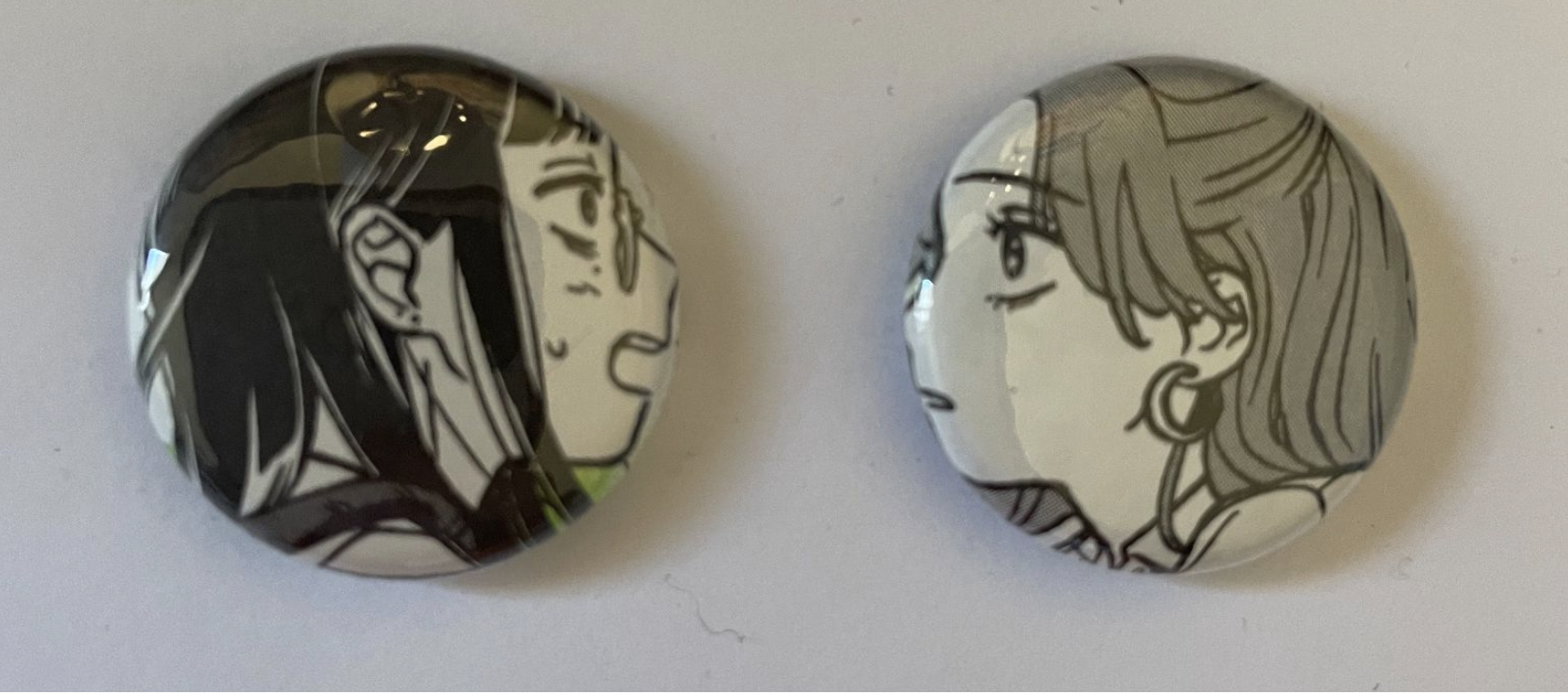
Buttons of The Guy She Was Interested In Wasn’t A Guy At All
Above all, I felt that we helped foster a community for anime lovers on campus with this event. Visitors sat together and chatted about their favorite anime, and were more than eager to talk with me, Kate, and Karen about all things anime and the work we’ve been doing for the library. I talked extensively with one visitor about why we had chosen the titles for the annotated bibliography, and she excitedly pointed out which ones she had seen and which ones she needed to watch. Our main goal for this event was to speak to people about the library’s anime collection and encourage them to browse it. I think, based on our amazing conversations, it was a success.
The number of project deliverables were daunting, especially laid out tangibly on paper. Yet, upon reflection through this blog and our final presentation, it’s incredible to think of how much work Kate and I completed, and how much we were able to contribute to research on anime to both the library and students on campus. I am so thankful to this opportunity for not only helping me gain valuable knowledge in research and library resources, but also for rekindling my love for anime.