
BLUElab Metro is far more than a typical student organization within the University of Michigan’s College of Engineering. We are a student-run, multidisciplinary team dedicated to a singular, powerful mission: to design sustainable, community-centered solutions that directly address local challenges while empowering the people most affected by them. We believe that true engineering excellence is found at the intersection of technical innovation and social responsibility. Our work focuses on long-term partnerships rather than short-term fixes, allowing us to design with our community members rather than just for them. This collaborative approach ensures that the outcomes are not just functional, but deeply tailored to the specific goals, cultural heritage, and needs of our partners.
Since 2023, our efforts have been entirely focused on a transformative partnership with Willow Run Acres (WRA), a nonprofit founded by T.C. Collins in Superior Township, Michigan. T.C. is a visionary community leader who views the land as a classroom and a tool for empowerment. Through WRA and the Clay Hill Community Farm, he works tirelessly to address food insecurity and the erasure of Black history in Washtenaw County. T.C.’s connection to farming is a generational legacy, handed down through ancestors who farmed under the most difficult circumstances of enslavement and sharecropping.
T.C.’s personal resilience is equally inspiring. After surviving a serious accident that left him disabled, he underwent extensive rehabilitation, yet his commitment to his community never wavered. Despite the physical toll on his body, T.C. has spent years manually hauling water across the farm to sustain the crops that feed and educate his neighbors. This exhausting, physically demanding labor is the primary reason behind our flagship initiative: the Smart Irrigation Project. Our goal is simple yet vital - to ease T.C.’s physical burden while improving the farm's water efficiency and productivity.
While our technical subteams focus on infrastructure, our relationship with Willow Run Acres is built on a foundation of shared time and mutual respect. Our team members don’t just visit the farm to install sensors; we are there nearly every weekend to support the farm’s broader mission. We participate in weekly volunteering events at the WRA site, helping with tasks needed to keep the farm thriving.
One of our favorite community outreach moments was collaborating with external organizations like Epsilon Eta, Society of Women Engineers, and Chi Epsilon, to host weekend events where we make seed biscuits. These moments allow us to step away from our laptops and breadboards to engage in the tactile, community-focused work that defines Willow Run Acres. These volunteering sessions and "build days" are essential to our process, fostering a sense of inclusion and a shared interest in sustainability among students and residents alike. We have learned that the relationships we build while working side-by-side in the dirt are just as important as the systems we build in the lab.
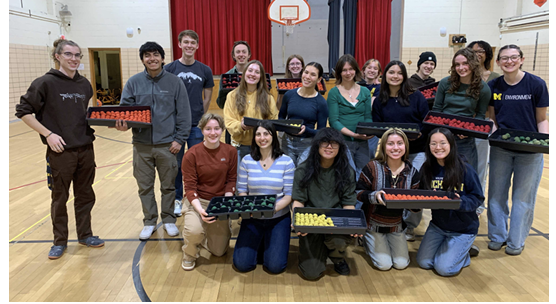
Making seed biscuits with Epsilon Eta
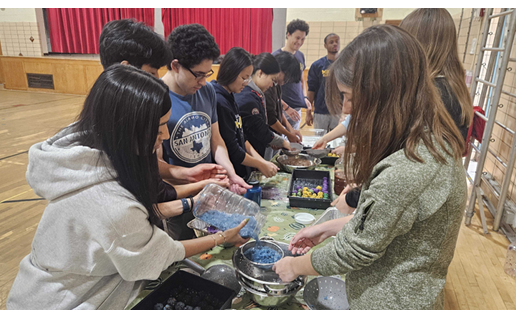
Making seed biscuits with Chi Epsilon
The Irrigation Subteam is currently developing a smart, automated system designed to optimize water use while prioritizing sustainability and long-term cost-effectiveness for T.C. Because the farm currently utilizes the city tap, our system focuses on making the watering process significantly more efficient and less labor-intensive, directly easing the physical burden T.C. faces when manually hauling water. We have moved away from the idea of rainwater collection to focus entirely on a system that monitors real-time soil and weather conditions, ensuring crops are watered with precision while saving the farm money on municipal water costs To manage this complex task, we have split our work into several key areas:
● Automation and Hardware: We are developing a sensor-based system using the LoRa and cellular based soil moisture sensing network. By cultivating an Agile workplace environment, our team prototypes hardware and software simultaneously, allowing us to pivot as we learn more about the farm's unique environment.
● Infrastructure: We have already implemented a base irrigation network using drip tape and sprinklers to provide immediate support to the farm while we finalize the automated controls.
● Community Tools: We are building a web application (waterrec.vercel.app) that will act as a dashboard for T.C. and the community to monitor the farm’s health. In addition to displaying live sensor data and GIS models, the site will briefly share the history of the land and the broader mission of Willow Run Acres, ensuring that the story of cultural heritage and food justice is integrated with our technical work.
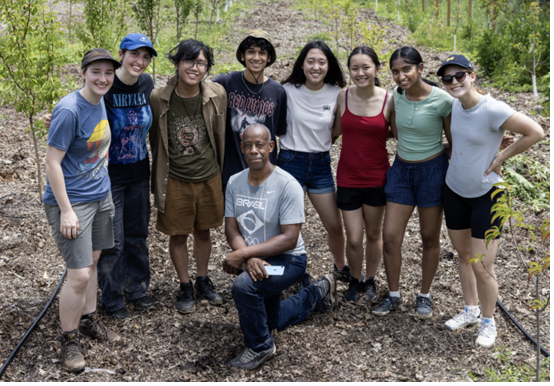
Summer 2025 Build Day!
Alongside our technical work on the irrigation system, our Solar Subteam plays a critical role in supporting WRA’s vision for a self-sustaining farm. They are currently building solar-powered picnic tables equipped with LED lighting and universal phone chargers. These tables will serve as outdoor classrooms for youth workshops and community gatherings, further turning Clay Hill into a restorative space for the entire township.
The technical precision of this project would not have been possible without the extensive support we received during our library consultations. We worked closely with GIS Specialists from the Clark Library, who provided us with the expertise and resources to deeply understand the land we are working on.
Through these consultations, we explored sophisticated software like QGIS, ArcGIS Online, and ArcGIS Pro. The specialists guided us in using Digital Elevation Models (DEM) to develop detailed graphics of the farm’s watershed. This allowed us to access critical data, including the USA SSURGO Erodibility Factor and Soil Hydric Class. These consultations turned what could have been simple guesswork into a data-driven design process, ensuring our irrigation layout follows the natural flow of the land.
Our research and modeling have already yielded significant insights. Our GIS work confirmed that Clay Hill is composed of very heavy clay soil, which presents specific drainage challenges. We discovered that half the area consists of alfisols (slow drainage) while the other half is mollisols (even slower drainage). Our soil data showed an erodibility factor of 0.34 and classified the site in Hydrologic Group C/D, meaning it has a naturally very slow infiltration rate due to a high water table.
With the support of the University of Michigan Library and other partners, this funding has been instrumental in moving our "Prototype Zero" forward. We have used these resources to acquire essential components, including electric valves, waterproof wiring enclosures, and soil moisture sensors. We have also successfully:
● Renewed the farm’s cellular plan and weather station subscription to ensure a constant stream of data.
● Successfully developed the first version of our watering algorithm, which utilizes live environmental data from the farm's weather station to inform irrigation decisions.
● Constructed a functional data logger in the lab to test our sensor network before on-site installation.
As we look toward Spring 2026, our team is focused on finalizing the automation network and ensuring the system is robust enough for long-term use. Our immediate next steps include:
1. Refining the Algorithm: We are working to reduce water waste further while optimizing plant growth. This involves not only improving our code but also integrating smart agricultural science insights gathered through our ongoing review of academic research papers to ensure our system is as effective and sustainable as possible.
2. Flume Room Testing: We will return to the university’s "Flume Room" to conduct rigorous reliability testing on our automation components.
3. On-Site Integration: We plan to return to the farm to install the prototype irrigation system integrated with weed fabric for better moisture retention.
4. Community Handoff: By Summer 2026, we aim to transition the operation and maintenance of these systems to the WRA volunteers we have trained. Our long-term vision is to help Willow Run Acres achieve full water and energy independence. We intend to publish our design materials as open-source resources so that other urban farms in Southeast Michigan can adopt these replicable, sustainable systems. Through this partnership, we have learned that engineering is not just about solving equations; it is about building relationships and using our skills to uplift those around us. T.C. Collins has shown us that when we design with compassion and community at the center, we can create a lasting impact that transcends the boundaries of the classroom.
Our long-term vision is to help Willow Run Acres achieve full water and energy independence. We intend to publish our design materials as open-source resources so that other urban farms in Southeast Michigan can adopt these replicable, sustainable systems. Through this partnership, we have learned that engineering is not just about solving equations; it is about building relationships and using our skills to uplift those around us. T.C. Collins has shown us that when we design with compassion and community at the center, we can create a lasting impact that transcends the boundaries of the classroom.