
As someone currently in the MSI (Master of Science in Information) program, I was on the hunt for any opportunity to work within an information space. I didn’t have much experience in said field, and so I was set on a mission to find a chance to work somewhere in the U-M Library throughout the academic year. And so when I discovered this position as an engagement fellow, I was immediately excited to both widen my scope and hone my skills as an information professional and work on a project with a subject matter that interests me personally.
The project, “Exploring Anime: Collections Research and Outreach Programming”, was focused on research, collection analysis, and outreach/programming with the AskWith Media library’s anime collection. Within the scope of our project, my project teammate Alina Murata and I defined “anime” as an audiovisual medium consisting of animated works of Japanese origin. Thus the overarching theme and question of our project was of the significance and relevance of anime within the library collection, as well as how that can be incorporated into programming.
In terms of collection research and analysis, we completed an inventory of anime titles, an Annotated Bibliography, Environmental Scan, and a recommended purchases inventory.
The inventory of titles were created first, and consisted of all of the anime titles (film and TV) in the AskWith Media library. The inventory was then divided into subcategories based on the dubbed language (Japanese and English) as well as film and TV.
Following the inventory’s completion, we then made the annotated bibliography, which was a comprehensive and curated list of anime titles from the library; dividing them into “stateless” anime (anime set in an ambiguous realm not based in reality, i.e. “mukokuseki” anime) and anime based in Japanese culture and stories. These titles were chosen to show the wide spectrum of the medium, hinging on the themes of anime as an incredibly diverse and engaging audiovisual genre.
This then led to our environmental scan, which compiled the different types of research we did in regards to the relevance of anime within the campus and the greater Ann Arbor area. This encompassed many different types of research and data gathering; from discussing with relevant parties (individuals within the U-M Library, student organization “Animania”, and the Ann Arbor District Library) as well as research into coursework, papers on Deep Blue, events held on campus and Ann Arbor, BTAA school courses and events, and a survey held in the lobby of the Shapiro Library.
The recommended purchases list we had created was based on all of the prior research for the project. We had recognized some gaps in subgenres, such as LGBTQ+ media, joseimuke (anime for adult women), and children’s anime based on our understanding of the genre and its relevance on campus.
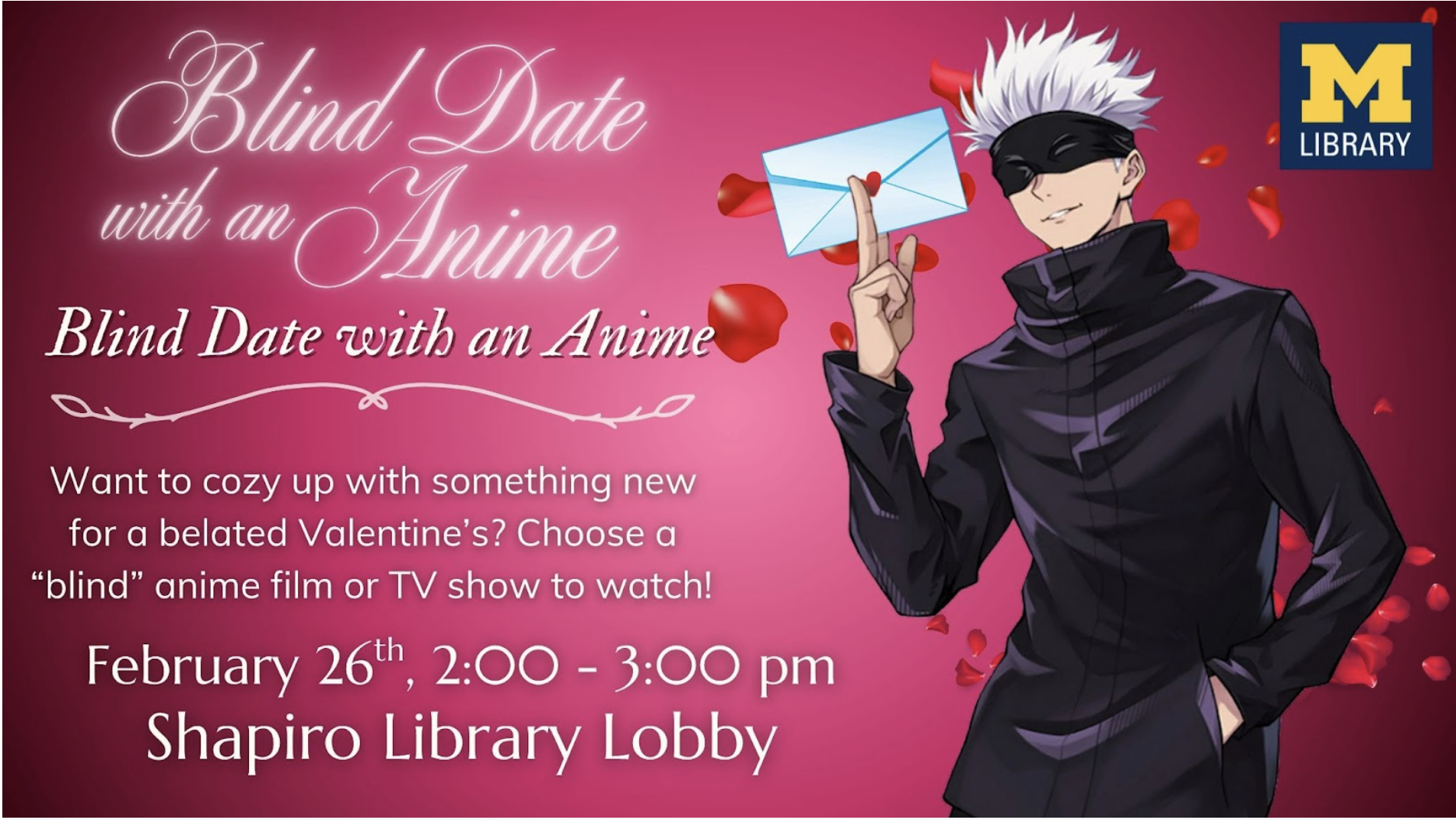
All of this cumulative research manifested into our two outreach events. Our first event was titled “Blind Date with an Anime”, and it entailed wrapped physical anime titles (Blu-Ray and DVDs) with summaries written and attached on top, making visitors choose based on description alone. Alongside this, we also created a matchmaking form, in which visitors would fill out a short questionnaire, and we would subsequently email them afterwards with recommended anime titles from the library. This event was aimed to be accessible and applicable to any level of familiarity with anime, and was aimed to increase awareness surrounding the anime collection and physical media collection at the library.
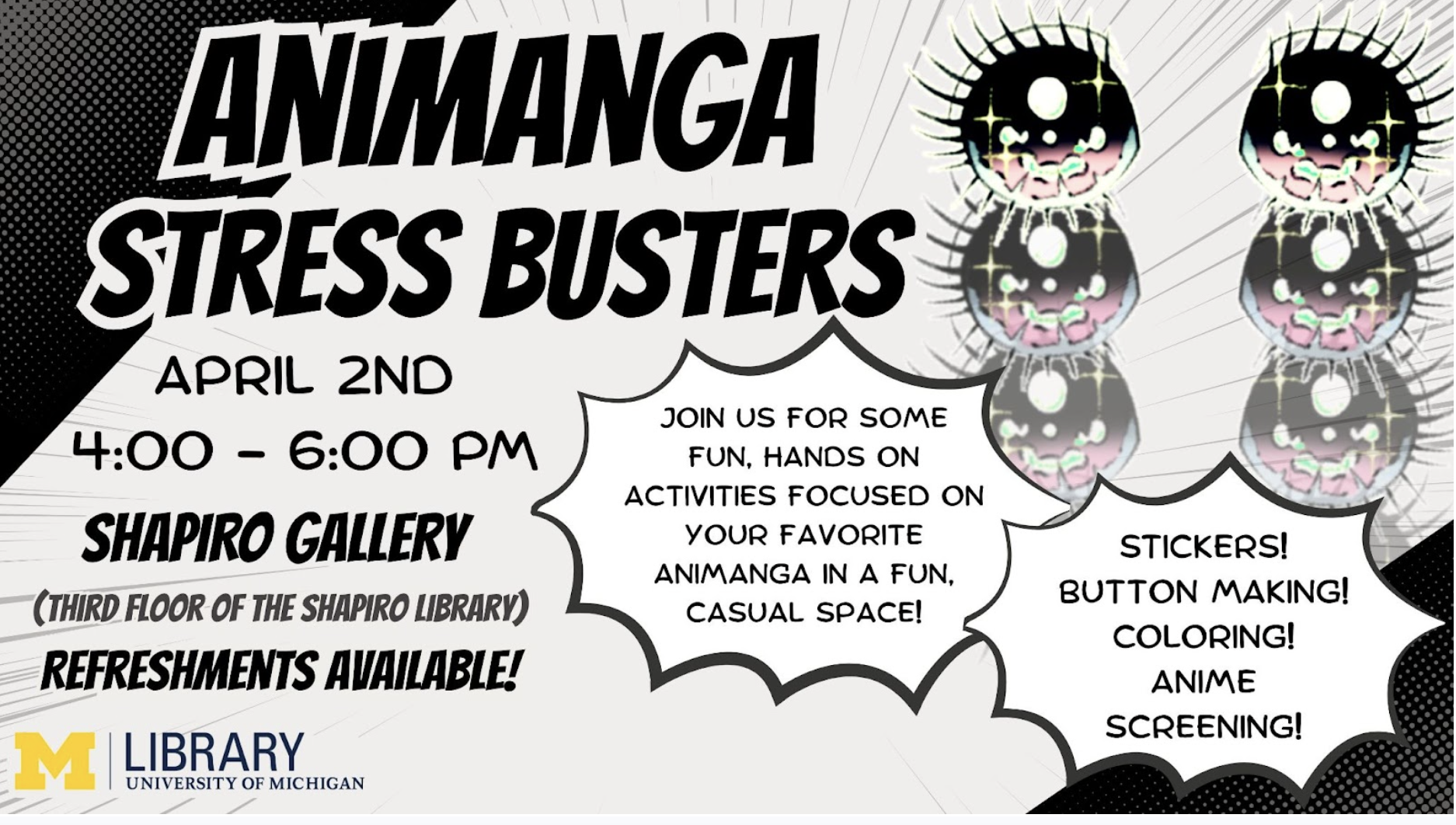
Our second outreach event was titled “AniManga Stress Busters”. This event was more-so tailored to and meant for users more thoroughly engaged in anime. During our research, we had noted a trend that even though there are campus individuals who are interested in anime on a personal level, there’s not much awareness surrounding anime and its collection in the library. Thus, our justification for the event was to provide a casual and fun space using library resources and used, donated manga to do various crafts and activities; ranging from sticker making, coloring sheets, button making, the aforementioned matchmaking form, and a screening of the film “Liz and the Blue Bird”.
These two programming activities were greatly beneficial and successful, and were very insightful for our conclusions regarding the project’s goals. As these portions of the project were primarily us engaging with the public, we better understood anime as a research subject on a more interpersonal level. Especially as our understanding of the subject prior to this was on a more academic level, it was a perceptive way for us to better understand how the library could engage with users more with anime as a subject matter.
Overall, the entire research processes and deliverables (including our outreach programming) had opened my eyes more on many different aspects of my personal interests, academic interests, and my future career goals. Anime is a genre I engage with personally, and so it was an amazing opportunity to delve deeper into the genre within a professional and academic setting. As mentioned prior, I was seeking more experience in a library setting to gain more experience in that field for my future career. And I can definitely ascertain that with all of the networking I did for the project, research methods and sources I had learned about and utilized, and getting the opportunity to work in a project that directly benefitted the AskWith Media Library collection, being a Student Engagement Fellow was a wonderful opportunity that gave me great opportunities to develop professionally.