
International Love Data Week 2026 is February 9-13, 2026. The theme this year is Where’s the Data? The U-M scholars who have shared their data publicly are enthusiastically answering this question.
Deep Blue Data is a repository offered by the University of Michigan Library that provides access and preservation services for digital research data that were developed or used in the support of research activities at U-M.
In honor of Love Data Week, we reached out to some recent Deep Blue Data depositors to ask about the history of their work, unique discoveries they made along the way, and how they see their data being useful to their research communities and beyond.
We hope you enjoy learning more about the scholars behind the data sets. As a reminder, all data sets in Deep Blue Data are openly accessible for anyone to download and use, because we love data.
Brian Derstine is a research staff analyst with the Morphomic Analysis Group (MAG), which uses machine learning to extract body composition measurements from medical imaging and builds models to understand how those measurements relate to medical outcomes, treatments, and population trends. Brian has been with the lab for over 10 years and specializes in research related to sarcopenia, the loss of muscle mass and function with age and disease. He deposited his data sets entitled "Dataset for: Relative muscle indices and healthy reference values for sarcopenia assessment using T10 through L5 computed tomography skeletal muscle area" and "Quantification of hepatic steatosis on post-contrast computed tomography scans using artificial intelligence tools [Dataset]" in Deep Blue Data. This research was conducted at the Morphomic Analysis Group (MAG), which is part of the Department of Surgery at Michigan Medicine. In this interview, he describes his research and why he decided to share his data set publicly.
What prompted you to conduct your research in this area?
For the first dataset, skeletal muscle is a major component of the human body, yet a rigorous definition of sarcopenia, based on a healthy reference population and properly adjusted for body size, was not adequately addressed in the literature. For the second dataset, Dr. Grace Su - Director of our lab and Chief of Gastroenterology at the VA Ann Arbor Healthcare System - was seeking a method of quantifying hepatic steatosis (liver fat) on CT scans that contained IV contrast. We had the right data and expertise to address both knowledge gaps.
For those not familiar with your field, what is the one thing you think is most important/interesting to know/unique about your work or your findings?
Most people are familiar with body mass index (BMI), a simple equation that normalizes body weight based on its underlying relationship to height. Similarly, we developed the concept of the relative muscle index (RMI), which normalizes torso musculature based on body size (height and BMI). Values above zero indicate ‘more muscular’ BMI, and values below zero indicate ‘less muscular’ BMI.
How do you hope your data might be encountered or reused out in the world?
We hope that other researchers can use our RMI and steatosis equations in their analyses to build more accurate and useful models.
What is one thing you learned during the process of preparing your data for deposit or sharing?
We believe our equations are correct and helpful, but they can be intimidating, so we provided images in our publication showing real examples of how they might change individual assessments of sarcopenia for people that might appear to be quite similar based on other standard metrics.
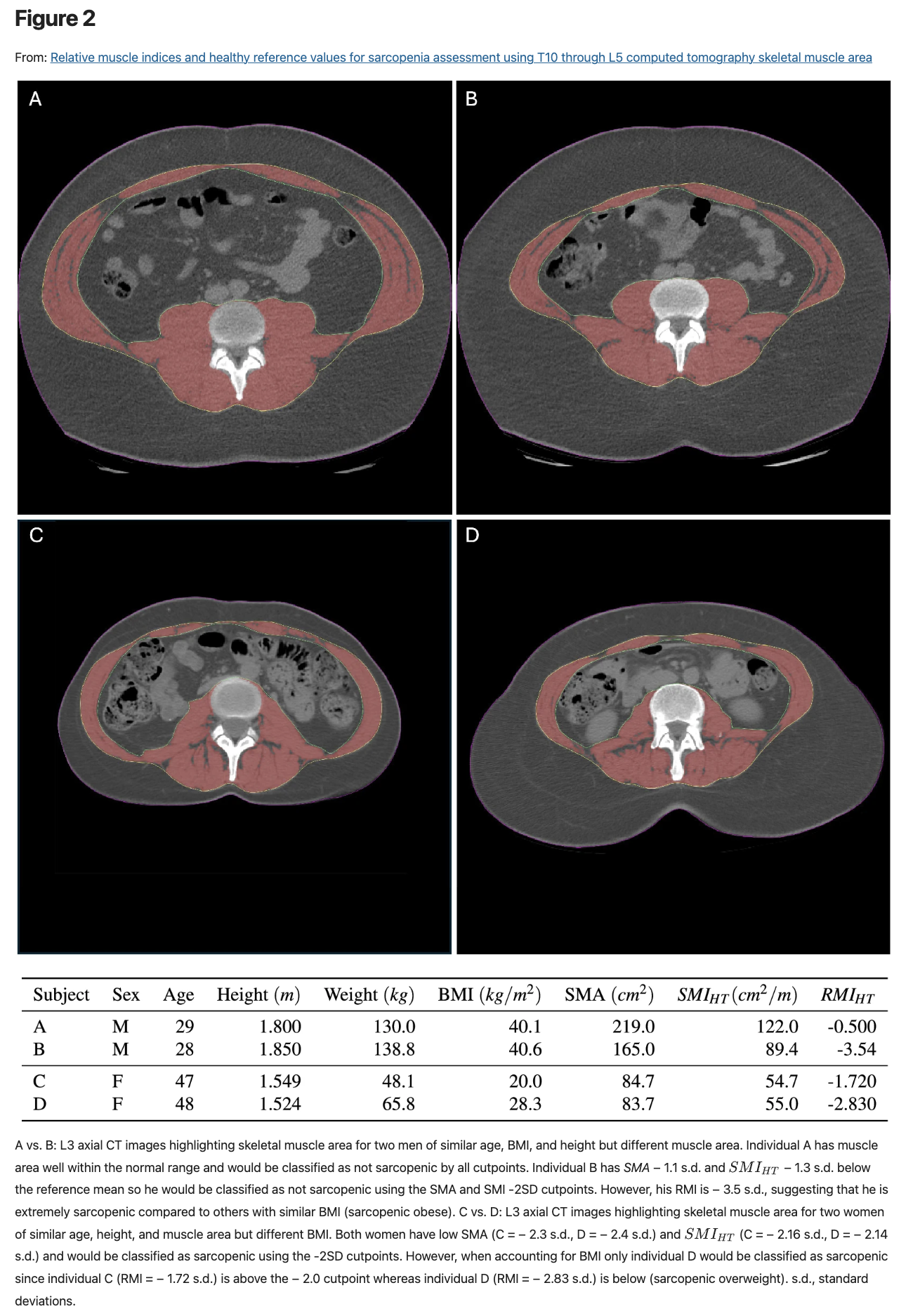
CT scans showing real examples of how individual assessments of sarcopenia for people that might appear to be quite similar based on other standard metrics (like height, weight and BMI) would change when measuring RMI.
Why do you think sharing data is important?
Sharing research data allows others to verify your work, which we believe enhances overall trust in science and research. Open datasets are important sources for education and for future researchers to use to further enhance our knowledge and understanding.