
It’s Open Access Week! While sharing knowledge openly is a public good, this year’s theme, “The Cost of Knowledge,” challenges us to think about the consistently rising cost of that sharing. Who benefits? Who is negatively impacted?
Deep Blue Documents (DB Docs), U-M’s institutional repository, is hosted and run by the U-M Library. It preserves and provides access to the teaching, learning, research, and creative materials produced at all three U-M campuses. It also contains digitized versions of many doctoral dissertations that were conferred at U-M.
As of October 2026, DB Docs contains 49,313 digital dissertations, the largest collection in the repository. While not comprehensive, it contains dissertations from 1884 to the present. Around 2010, the Rackham Graduate School started requiring doctoral students to submit digital dissertations instead of print dissertations. With this shift, Rackham additionally started requiring that these students give permission for their dissertation to be publicly available in DB Docs. While most dissertations from the past fifteen years are open access, 93.6% published before 2010 were restricted to access by U-M users only. This is because we didn’t have consent of the copyright holder (the dissertation author) to make these older dissertations publicly available; thus, we restrict access to older dissertations to U-M users only, akin to someone using the print copy from the U-M Library collection.
We know that there is significant interest in reading and reusing U-M dissertations by people outside of U-M because we received many of their requests (sometimes daily!) asking for access to a dissertation restricted to U-M users. (To learn about these requests, see our previous blog post, Why making U-M dissertations freely available online matters to the general public.)
Below is a summary of projects we’ve done to investigate the copyright status of many dissertations in DB Docs that were restricted to U-M users. Based on these projects, we’ve been able to open access to 10,041 dissertations that were previously restricted to U-M users only.
Contacting the author when their dissertation was requested by someone outside of U-M
When we receive a request from a person outside of U-M asking for access to a dissertation restricted to U-M users, we identify the author and try to contact them. We ask them, as the copyright holder, to consider sharing a copy with the requestor and opening access to their dissertation. Most authors readily agree. Using this process, we opened approximately 90 dissertations. However, this process was time- and labor-intensive, and we are dependent on someone outside of U-M contacting us for access. It is also likely that many people who couldn’t access a dissertation but didn’t contact us.
Identifying and opening access to dissertations that are likely in the public domain
In collaboration with the U-M Library’s Copyright Office and U-M’s Office of General Counsel, we reviewed US copyright laws and developed a workflow to identify dissertations that were likely in the public domain, meaning they could be made open available without contacting the author.
Dissertations that were published 95 years ago are in the public domain
Based on our interpretation of US copyright law, dissertations published 95 years ago or earlier fall into the public domain, so DB Docs staff have been opening them on an annual rolling basis. This means that, as of 2026, dissertations published before 1933 are in the public domain and have been made openly available in DB Docs. Next year (2027), we will open access to dissertations published before 1934.
As of October 2026, there are 51 dissertations published before 1933 that are now openly available in DB Docs.
Dissertations that were published before 1978 and don’t have a valid copyright notice are likely in the public domain
A valid copyright notice on the title page or pages immediately following is required for dissertations published before 1978 to be eligible for copyright protection. So, if a pre-1978 dissertation does not contain a copyright notice in the front matter, then it is likely in the public domain, and we can open access to it.
Automated review of copyright notices
During 2025, we wanted to look for copyright notices in the 13,290 dissertations published between 1930 and 1977 that were restricted to U-M users only; however, this was too large a number to do a manual review.
In collaboration with a Master’s student from the U-M School of Information, we worked to develop an automated method using Python code to detect copyright notices in the front matter of dissertations. For each dissertation (in PDF format), an optical character recognition (OCR) text file was created (if not already present). Then, the first and last 15 pages of the text file were extracted and analyzed for a copyright notice using fuzzy text matching. This type of matching was used to address OCR errors, text degradation, and inconsistent formatting of the copyright notices. (A slightly technical overview of this pipeline is available here.)
Because all of these dissertations were originally in print and then digitized, this was a difficult task due to the wide variety of quality of the scans as well as the variety of formats for the title page. For example, the image below shows the variety of formatting for title pages of six representative dissertations in this corpus.
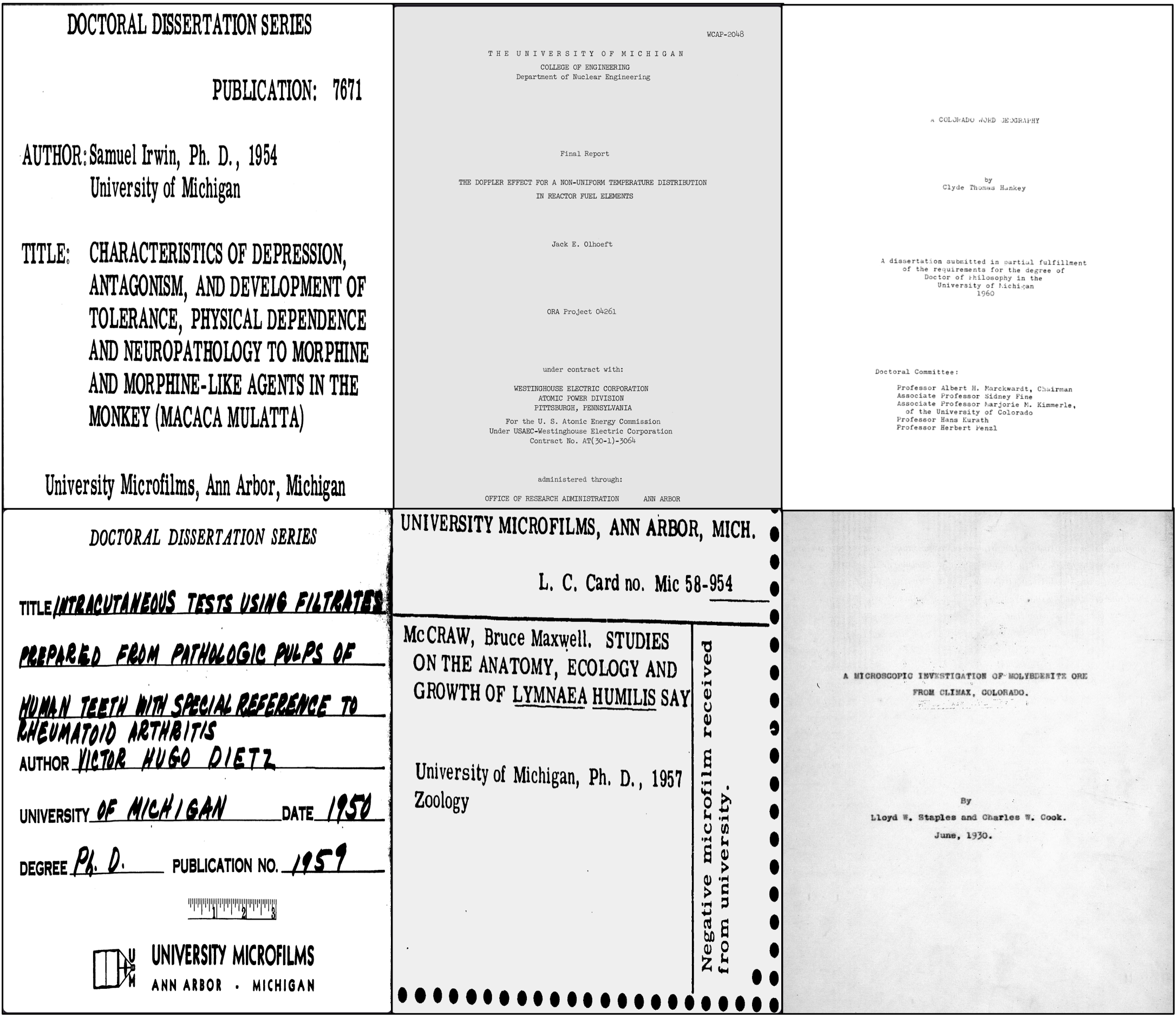
These title pages from six dissertations show the wide variety of formatting, including some partially handwritten title pages.
Additionally, identifying a copyright notice can be difficult due to the variety of their appearance, spelling, or location. Some were even handwritten. The six examples below are from dissertations in this corpus, and this isn’t an exhaustive list of how copyright notices appear!
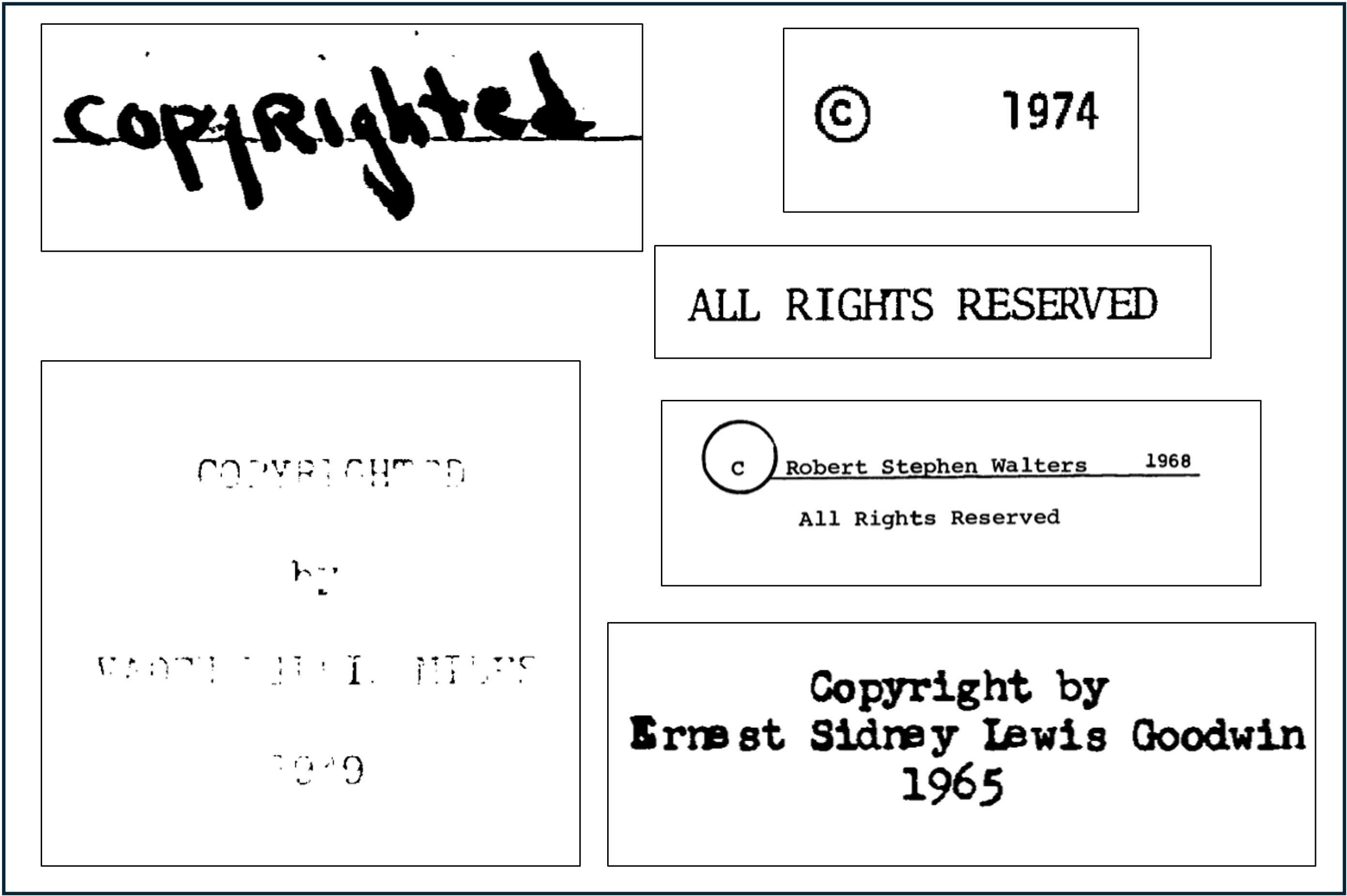
A copyright notice can appear in many different formats, including the six shown above.
Our Master’s student tweaked the Python code over several months. To validate the code, they manually reviewed the front matter of 853 dissertations and compared them to the results of the code. The code was validated to be highly accurate, achieving 99.77% accuracy (only two incorrect results out of a total of 853 dissertations).
Applying the code to the full corpus of 12,434 pre-1978 dissertations identified:
- 2,799 with a valid copyright notice,
- 8,346 without a valid copyright notice, and
- 1,367 with indeterminate copyright status that would need to be manually reviewed.
(The 857 digitized dissertations in DB Docs published between 1947–1952 were excluded from the final analysis due to irrecoverable OCR issues. These would need to be manually reviewed; these results are discussed in the following section.)
The results of this automated review allowed us to open access to 8,346 dissertations.
Manual review of copyright notices
With generous funding from the Rackham Graduate School, we were able to hire two additional graduate students to manually review the 2,252 dissertations whose copyright status hadn’t been determined during the automated review process. Each dissertation’s front matter was manually reviewed for the presence or absence of a copyright notice by two people. If both reviewers agreed that there wasn’t a copyright notice, the dissertation was opened to the public. An unexpected benefit of this manual review is that we identified and re-digitized six dissertations because the wrong dissertation had been digitized or the print was too faint to be legible.
The results of this manual review allowed us to open access to 1,401 dissertations.
Unlocking Dissertations Project
The Unlocking Dissertations Project, a partnership between the U-M Library and the Rackham Graduate School, is working to contact doctoral alumni about opening access to their dissertations. This project is part of the university’s celebration of 150 years of doctoral education at U-M.
As detailed above, for dissertations published before 1978, we were able to use the presence or absence of a copyright notice in the front matter to determine if access to a dissertation could be opened from U-M only to open access. Starting in 2010, dissertations were born digital, which means they were created on a computer and not scanned from a physical copy. Deposit of dissertations in DB Docs has been a requirement for completing the doctoral degree around that date. From that time, while an author may choose to impose a limited term embargo, all dissertations are eventually made publicly available.
This left a significant number of dissertations, particularly those published between 1978 and 2010, restricted to U-M users only.
During the summer of 2026, Rackham sent information to doctoral alumni about The Unlocking Dissertations Project, offering them the option to open access to their dissertation. We received 155 responses from interested alumni.
As a result of this outreach, 126 dissertations were made publicly available.
Conclusions
From these projects, we opened access to 10,014 dissertations, which accounts for approximately 46% of the pre-2010 dissertations that were restricted to U-M users only.
Opening access to over 10,000 dissertations has reduced the need for people outside of U-M to contact us for access. While we thoroughly enjoy reading about their connections to these dissertations, we’re excited that so many more dissertations are freely available online for the general public to access.
In addition to investigating the copyright status of thousands of dissertations, we’ve also completed several projects identifying print dissertations in the U-M Library collection that currently aren’t available digitally in DB Docs. See our other blog post to learn more: Identifying, Digitizing and Uploading 95 UM dissertations into Deep Blue Documents.
Acknowledgements
Many kudos to Rachel Woodbrook for being the driving force behind many of our projects to make U-M dissertations more accessible to the public. Huge thanks to Aurelia Hudak, who did the majority of the work in creating an automated workflow for identifying copyright status in digitized dissertation front matter. Thanks to our amazing graduate student assistants, Katie Cutts, Lucía González González, and Remi Foust, for their diligent work manually investigating the copyright status of many U-M dissertations and for corresponding with over 150 authors to open access to their dissertations. Thank you to our colleagues in the Development Office (Yvonne Greenhouse and Katrina Klaphake in particular) for supporting these efforts. Sincere thanks to the Rackham Graduate School for their financial support for these projects and partnering with us on the Unlocking Dissertations Project, especially Truly Render-Wagner for writing such thought provoking projec summaries. Finally, thanks to our colleagues who have advised on and supported this work, including Jeremy York, Melissa Levine, Jack Bernard, Charles Watkinson, and Jeremy Morse.