
Anna Thomas was born to Polish parents in Stuttgart, Germany and immigrated to the United States with her family as an infant and grew up in Detroit. She moved to California to study film at UCLA, but her biggest cultural impact would come not on the screen, but in the kitchen.
Although there was growing interest in healthy eating and vegetarianism in the late 1960s and early 70s, there were relatively few vegetarian cookbooks widely available, and even fewer that emphasized making food enjoyable as well as ethical. When Anna Thomas pitched the original Vegetarian Epicure as a way to fund a film she was working on as a student, she didn’t expect much beyond the $3,000 advance she received from the publisher. However, her book struck a chord in the burgeoning American counterculture and quickly became a classic, serving as an inspiration for other household names of vegetarianism, like the now-famous Moosewood Collective.
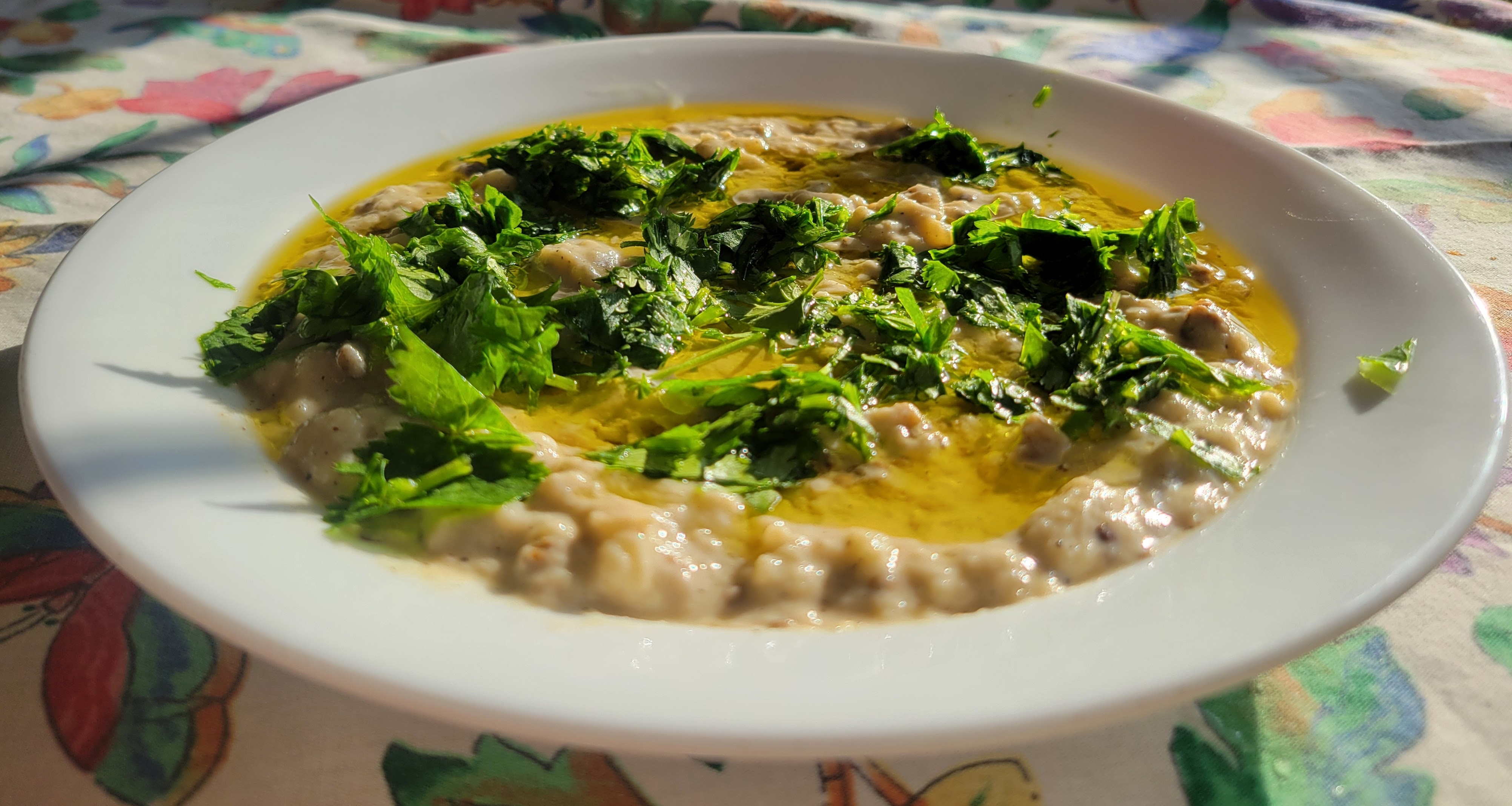
In 1978, Thomas published a sequel, The Vegetarian Epicure. Book Two, which went through numerous printings (JBLCA holds the 8th printing, issued in 1981). For this month’s recipe of the month, I decided to try Thomas' “baba ghanouj” from this volume which she describes to those unfamiliar with it as “a salad of eggplant and sesame paste.”
Baba Ghanouj
Serve with crackers or with hot pita bread as a first course
1 lb eggplant
¼ cup Taratour Sauce (page 105)
¼ cup fresh lemon juice
1 tsp. Salt, or more to taste
¼ tsp. Pepper
1 Tbs. plus 1 tsp. Olive oil
2 Tbs. chopped fresh cilantro (coriander leaves), or more to tastePrick the eggplant with a fork in several places and roast it in a preheated 400 degree oven for 45-55 minutes, or until it is soft throughout. When the eggplant is cool enough to handle, cut it in half and scrape out all the pulp.
Mince the eggplant pulp and add to it the Taratour Sauce, lemon juice, salt, pepper, and 1 tablespoon of the olive oil. Stir the mixture thoroughly, taste it, and correct the seasonings.
Spread the eggplant mixture evenly in a shallow serving dish, drizzle the remaining olive oil on top of it, sprinkle with chopped cilantro, and chill for several hours before serving.
Serves 4 to 6.
While Thomas’ first book drew primarily on her own experiments as a vegetarian college student, her second volume drew on her experiences traveling and exploring new-to-her cuisines. She writes,
I spent the last four years traveling…Work and whim took me through large parts of Europe -- Portugal, Spain, Italy, France, Greece, Austria, Hungary, Poland -- as well as to England, on a brief sally into the Middle East, and on a jaunt through Mexico. Everywhere I went, I was delighted by the food, by the rewards of being eager to sample the new and unfamiliar.
Thomas sought to share these “new” ways eat vegetables with new and returning epicurean readers, emphasizing that “the good things in this book are meatless, but it is not a book for vegetarians only. It is for anyone…” This welcoming approach has been key to her enduring appeal as she presents vegetarianism as a path to pleasure and possibility, rather than abstinence and deprivation.
Many of the recipes Thomas presents, like hummus and baba ghanoush, have now become everyday staples throughout the United States. For my own part, I didn't I didn’t encounter hummus until I was a college student adventurously eating dinner at a Moroccan restaurant in the early 2000’s, but twenty years onward, every grocery store in Ann Arbor stocks multiple brands and flavors (sometimes even the much debated chocolate hummus!)
Thomas’ 1981 baba ghanouj is similar to contemporary recipes I’ve encountered on the internet, though perhaps with a little more black pepper, no cumin, and far less oil (only 1 tablespoon, compared to Serious Eats’ ⅓ cup! The key difference is that Thomas’ recipe minces the eggplant pulp, rather than pureeing it (making this a lower tech, albeit also less creamy, dish) and does not call for draining the eggplant pulp. It took a little bit of fortitude to skip that step, but the result is not unpleasant, even if it is a little more watery than the commercial or home made baba ghanoush I’ve made in the past. As one final note, this recipe also shows how Thomas’ builds one recipe upon another through her book. Rather than simply adding tahini, lemon juice, water, and garlic directly in the baba ghanouj recipe, she calls on the reader to make Taratour Sauce (a tahini based recipe containing the aforementioned ingredients) and then add a portion of that to the baba ghanouj. Her Taratour Sauce makes quite a sizeable quantity, since it uses 1 cup of tahini, so there is plenty left for drizzling!
Bibliography:
Levitt, Aimee. “‘The Vegetarian Epicure’ Extolled the Joy of Vegetables,” Eater.com. July 27, 2023. https://www.eater.com/23802349/the-vegetarian-epicure-anna-thomas
“‘Bringing Vegetarian Cooking to New Gastronomic Heights:’ Reviewing The Vegetarian Epicure.” The Kitchen Review of Books. July 12, 2021. https://kitchenreview.substack.com/p/bringing-vegetarian-food-to-new-gastronomic
“Vegan, Vegetarian, Omnivore: The Food Writing of Anna Thomas.” Accessed February 27, 2026. https://annairenathomas.wixsite.com/mysite/about-anna